
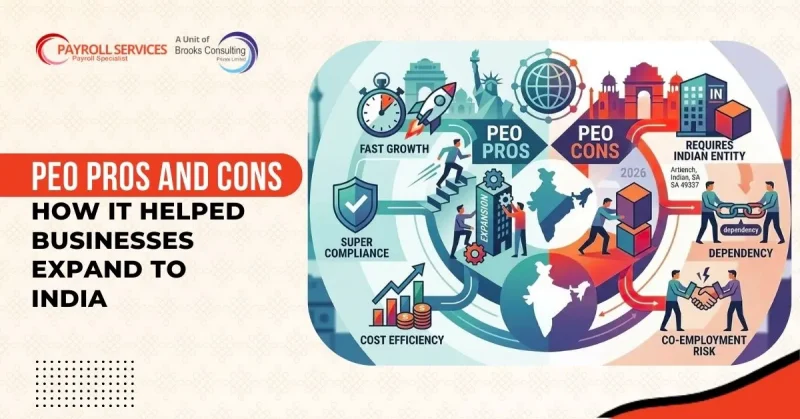
PEO Pros and Cons: How It Helped Businesses Expand to India
Expanding into India is a strategic move for global companies looking to tap into a large talent pool and a fast-growing economy. However, navigating India’s complex labour laws, payroll systems, and compliance requirements can be overwhelming.
This is where a Professional Employer Organization (PEO) plays a crucial role.
In this blog, we’ll explore the pros and cons of PEO services and how they have helped businesses successfully expand into India.
What is a PEO in India?
A Professional Employer Organization (PEO) is a service provider that enters into a co-employment relationship with your company.
While you manage day-to-day operations, the PEO handles:
- Payroll processing
- Statutory compliance (PF, ESI, TDS)
- Employee benefits
- HR administration
- Labour law compliance
Unlike an EOR, a PEO requires your business to have a registered entity in India.
Why Businesses Use PEO Services in India
India’s regulatory environment includes:
- Central and state-level labour laws
- Mandatory PF & ESI contributions
- Professional tax variations
- Complex payroll structures
For foreign companies or growing businesses, managing this internally can slow down expansion.
PEO services simplify this process by outsourcing HR and compliance.
Pros of PEO Services in India
1️⃣ Faster Workforce Expansion
With a PEO, businesses can onboard employees quickly without building an in-house HR team.
This is especially useful for:
- Startups entering India
- Companies scaling rapidly
- Project-based hiring
2️⃣ Reduced Compliance Risk
A PEO ensures adherence to Indian labour laws, including:
- PF & ESI filings
- TDS deductions
- Gratuity compliance
- Labour law updates
This minimizes the risk of penalties and legal complications.
3️⃣ Cost Efficiency
Hiring an internal HR, payroll, and compliance team can be expensive.
PEO services help reduce:
- HR overhead costs
- Payroll software expenses
- Compliance management costs
4️⃣ Access to HR Expertise
PEO providers bring deep expertise in:
- Indian employment laws
- Compensation structuring
- Employee benefits
This ensures better workforce management.
5️⃣ Focus on Core Business
By outsourcing HR functions, businesses can focus on:
- Growth strategy
- Sales & operations
- Market expansion
6️⃣ Scalability
PEO services allow businesses to:
✔ Easily increase or decrease workforce
✔ Manage multi-location hiring
✔ Handle seasonal workforce demand
Cons of PEO Services in India
1️⃣ Co-Employment Structure
Some companies may find the co-employment model complex, as responsibilities are shared between employer and PEO.
2️⃣ Less Direct Control Over HR Processes
Since HR functions are outsourced, companies may have:
- Limited control over policies
- Dependency on PEO processes
3️⃣ Requires Indian Entity
Unlike EOR, a PEO requires:
- A registered company in India
This may not suit businesses testing the market.
4️⃣ Long-Term Cost Consideration
For very large teams, maintaining an in-house HR department may eventually become more cost-effective.
5️⃣ Dependency on Service Provider
Quality of service depends heavily on the PEO provider’s expertise and reliability.
How PEO Helped Businesses Expand to India
🚀 Case Scenario 1: Startup Expansion
A US-based SaaS startup wanted to build a tech team in India.
Challenges:
- No HR team in India
- Lack of compliance knowledge
Solution:
Used a PEO provider to:
- Hire developers quickly
- Manage payroll & compliance
Result:
✔ Hired 10 employees in 2 months
✔ Zero compliance issues
🚀 Case Scenario 2: Multi-State Hiring
A manufacturing company expanded operations across multiple Indian states.
Challenges:
- Different state laws
- Complex payroll
Solution:
PEO handled:
- Multi-state compliance
- Payroll standardization
Result:
✔ Smooth operations across locations
✔ Reduced HR workload
🚀 Case Scenario 3: Scaling Without HR Team
A growing company needed to scale from 20 to 100 employees.
Solution:
PEO managed:
- HR policies
- Employee onboarding
- Compliance
Result:
✔ Faster hiring
✔ Reduced operational complexity
PEO vs EOR: Which is Better for India Expansion?
| Factor | PEO | EOR |
| Requires Indian entity | Yes | No |
| Employment model | Co-employment | Full employment |
| Compliance handling | Shared | Fully outsourced |
| Best for | Established companies | Market entry |
When Should You Choose PEO?
PEO is ideal if:
✔ You already have an Indian entity
✔ You want to outsource HR & compliance
✔ You are scaling operations rapidly
✔ You want to reduce administrative burden
Final Thoughts
PEO services offer a powerful solution for businesses expanding into India by simplifying HR operations and ensuring compliance.
While there are some limitations, the benefits — especially in terms of compliance, scalability, and cost efficiency — make PEO a valuable partner for growing companies.
Choosing the right PEO provider can significantly impact your expansion success in India.
FAQ Section
1. What is a PEO in India?
A PEO is a service provider that manages HR, payroll, and compliance under a co-employment model.
2. Is PEO legal in India?
Yes, PEO services operate legally under Indian labour laws.
3. What is the difference between PEO and EOR?
PEO requires an Indian entity, while EOR acts as the legal employer.
4. Is PEO suitable for startups?
Yes, if the startup has a registered entity in India.
5. How much do PEO services cost in India?
Costs vary based on employees, services, and compliance requirements.