
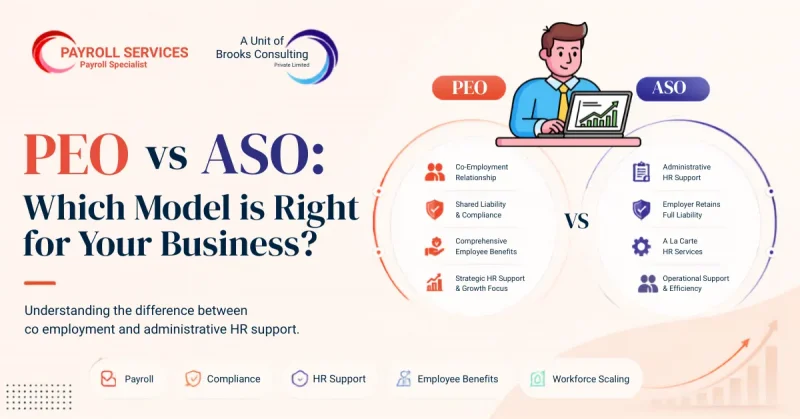
PEO vs ASO: Which Model is Right for Your Business?
As businesses grow, managing human resources, payroll, employee benefits, and compliance becomes increasingly complex. Many organizations choose to outsource these responsibilities to improve efficiency, reduce costs, and focus on their core operations.
Two of the most popular HR outsourcing models are Professional Employer Organization (PEO) and Administrative Services Organization (ASO). Although both help streamline HR functions, they differ significantly in terms of legal responsibility, compliance, and employer control.
If you’re planning to expand your workforce in India or improve your HR operations, understanding the difference between PEO vs ASO will help you choose the right model for your business.
What is a Professional Employer Organization (PEO) ?
A Professional Employer Organization (PEO) works under a co-employment model.
In this arrangement:
- Your business continues to manage employees’ daily work.
- The PEO shares employer responsibilities for HR administration and compliance.
A PEO typically manages:
- Payroll processing
- Employee benefits
- HR administration
- Statutory compliance
- Employment documentation
- Labour law support
A PEO is ideal for businesses that want professional HR support while continuing to manage their workforce.
What is an Administrative Services Organization (ASO) ?
An Administrative Services Organization (ASO) provides HR and payroll administration services but does not become a co-employer.
With an ASO:
- Your company remains the sole legal employer.
- The ASO provides administrative support only.
Typical ASO services include:
- Payroll processing
- HR administration
- Benefits administration
- Time and attendance management
- HR documentation
- Employee record management
Unlike a PEO, the ASO does not assume shared employer responsibilities.
PEO vs ASO: Key Differences
| Feature | PEO | ASO |
| Employment Model | Co-employment | Administrative support only |
| Legal Employer | Shared responsibility | Client company only |
| Payroll Processing | ✔ | ✔ |
| HR Administration | ✔ | ✔ |
| Compliance Support | Extensive | Advisory/Administrative |
| Employee Benefits Management | ✔ | ✔ |
| Labour Law Responsibility | Shared | Client responsibility |
| Best For | Growing businesses needing HR support | Companies with established HR teams |
How Does a PEO Work ?
With a PEO:
- Employees work for your business.
- The PEO assists with HR and compliance.
- Payroll and statutory filings are managed by the PEO.
- Your company retains operational control.
This shared responsibility reduces administrative burden while improving compliance management.
How Does an ASO Work ?
With an ASO:
- Employees remain fully employed by your company.
- The ASO provides administrative assistance.
- Payroll is processed by the ASO.
- Your company retains full legal responsibility for employment compliance.
This model gives businesses greater control but also greater responsibility.
Benefits of Using a PEO
1. Reduced Compliance Risk
A PEO helps businesses comply with:
- Labour laws
- Payroll regulations
- Statutory deductions
- Employee documentation
This reduces the likelihood of compliance errors and penalties.
2. HR Expertise
PEOs provide experienced HR professionals who assist with:
- Policy development
- Employee relations
- Performance management
- Compliance updates
3. Better Employee Benefits
Many PEOs help businesses manage employee benefit programs more efficiently.
4. Easier Workforce Scaling
Growing companies can expand their workforce without building a large internal HR department.
5. Time and Cost Savings
By outsourcing HR administration, businesses can focus on revenue-generating activities instead of administrative tasks.
Benefits of Using an ASO
1. Greater Employer Control
Your business retains complete authority over:
- HR policies
- Employee decisions
- Compliance management
2. Administrative Support
ASOs reduce workload by handling:
- Payroll processing
- HR documentation
- Benefits administration
3. Flexible HR Outsourcing
Companies can outsource administrative functions while keeping strategic HR decisions in-house.
4. Lower Cost for Businesses with Existing HR Teams
Organizations that already have experienced HR professionals may find ASO services more economical than a PEO.
When Should You Choose a PEO ?
A PEO may be the better choice if:
✔ Your business is growing rapidly
✔ You need help managing compliance
✔ You have a small HR team
✔ You want professional HR expertise
✔ You want to outsource payroll and HR administration
When Should You Choose an ASO ?
An ASO is suitable if:
✔ You already have a strong internal HR department
✔ You only need administrative support
✔ You want to retain full employer responsibility
✔ You have established compliance processes
PEO vs ASO: Which Model is Better for Businesses in India ?
The answer depends on your business needs.
A PEO is often ideal for:
- Small and medium-sized businesses
- Companies expanding rapidly
- Businesses seeking compliance support
- Organizations wanting end-to-end HR assistance
An ASO is often ideal for:
- Large organizations
- Companies with experienced HR teams
- Businesses needing payroll and administrative support only
Factors to Consider Before Choosing
Before selecting either model, ask yourself:
- Do we need compliance support?
- Do we have an internal HR team?
- How quickly are we planning to scale?
- What level of employer responsibility do we want to retain?
- Is our priority reducing administrative work or maintaining complete control?
Answering these questions will help you identify the right solution.
Final Thoughts
Both PEO and ASO services can improve HR efficiency, but they serve different business needs.
If you’re looking for a comprehensive HR solution with compliance support and workforce scalability, a PEO is usually the better option.
If your company already has an experienced HR department and simply wants administrative assistance while retaining full employer responsibility, an ASO may be the more appropriate choice.
Choosing the right model depends on your growth plans, internal HR capabilities, and long-term business objectives.
FAQS
1. What is the main difference between a PEO and an ASO?
A PEO operates under a co-employment model and shares certain employer responsibilities, while an ASO only provides administrative HR services and your company remains the sole employer.
2. Which is better for small businesses?
A PEO is generally better for small and growing businesses because it offers HR expertise, payroll management, and compliance support.
3. Does an ASO manage payroll?
Yes. ASOs commonly provide payroll processing, employee records management, and HR administration.
4. Is a PEO more expensive than an ASO?
PEO services may cost more because they include broader HR support and compliance management. However, they can also reduce costs associated with hiring internal HR staff and managing compliance.
5. Can international companies use a PEO in India?
Yes. Businesses that already have a registered entity in India can use a PEO to manage HR, payroll, and compliance more efficiently.