
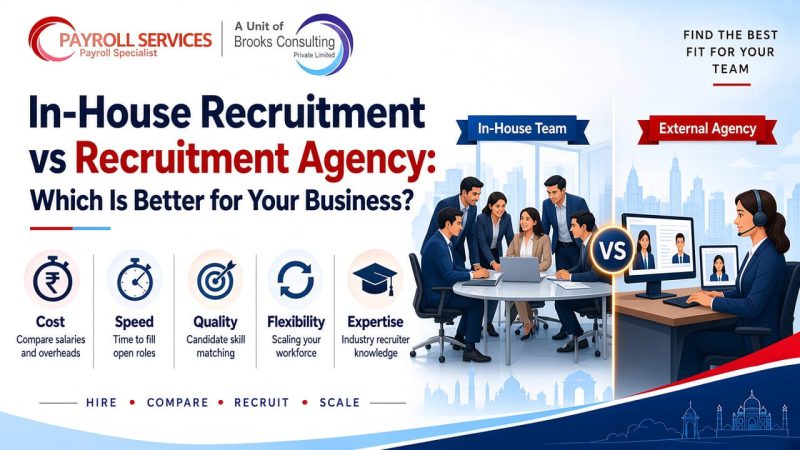
In-House Recruitment vs Recruitment Agency: Which Is Better for Your Business?
Choosing the Right Recruitment Strategy for Business Growth
Hiring the right employees is the most substantial decision for any company. A competent workforce will ensure a higher productivity, better company culture, more innovations, and overall successful performance of the company in the long run. However, finding suitable professionals is not always a simple task, especially when you have a number of vacancies to fill at once.
This leads to a important question: Is it better for the company to hire by itself or resort to a recruiting company?
There are several factors to take into account when comparing in-house recruitment vs recruitment agency services, not just the costs of hiring. Speed of recruitment, availability of qualified candidates, HR internal capacities, hiring expertise, and scalability are all factors that are important.
An in-house recruitment allows companies to have control over the recruitment process, while recruitment agencies have specialist expertise, access to networks of potential recruits and more recruitment support. The right one might be based on what you are looking for in your organisation, your workforce plans and resources available.
This guide will provide a comparison between in-house recruitment and recruitment agencies, advantages and disadvantages of both types of recruitment and the reasons for choosing the best recruitment method for business.
What Is In-House Recruitment?
In-house recruitment is a hiring method where a company’s internal HR team or a specific HR recruiter will handle the entire recruitment process. Their duties include job posting, sourcing candidates, screening applications, conducting interviews, communicating with hiring managers and making offers.
There are some firms that are established that prefer the in-house recruiting approach since it enables them to have a close eye on the recruiting approach and the candidate’s experience.
How Does In-House Recruitment Work?
Typically, the recruitment process within the organisation follows the steps of:
- Identifying the work force needs and job openings.
- Making job descriptions and recruitment strategies.
- Promoting job openings on online recruitment sites and on the company career website.
- Searching for candidates through professional groups and referrals from employees.
- Evaluating CVs and performing preliminary evaluations.
- Arranging interviews with hiring managers.
- Negotiating salary and job offers.
- Assisting with recruiting and keeping track of recruiting files.
Advantages of In-House Recruitment
1. Greater Control Over Hiring
Internal HR team can handle hiring policies, the criteria for selecting candidates, interviews, and hiring decisions. This aligns the recruitment process with the business’s objectives.
2. Better Understanding of Company Culture
Insiders understand the values of the firm, the various aspects of the working environment, the expectations of the organization, and the workings of the teams involved. This knowledge, in turn, helps in locating suitable candidates.
3. Direct Communication With Hiring Managers
Internal recruiters can have conversations regarding the expectations of employees and department heads in order to know the requirements to have that role and the technical skills needed.
4. Long-Term Recruitment Capability
Organizations with ongoing hiring needs can acquire internal recruitment know-how, build talent pools, and develop holistic recruitment practices.
5. Potential Cost Efficiency for Consistent Hirin
Depending on the company’s workforces, technology, and the amount of recruiting, it may be cost-effective for the company to have an in-house HR team for recruiting in multiple departments.
Disadvantages of In-House Recruitment
In-house recruitment has its pros and cons, however, there are a number of challenges to look out for.
- High fixed costs: Salaries, recruitment software, job portal subscription, training can do the cost of operations rise.
- Limited candidate reach: Internal teams may not be able to reach candidates who are not readily accessed in their networks such as specialised candidates or passive candidates.
- Time-consuming processes: Sourcing, screening, interviewing and coordinating candidates can be very time-consuming.
- Limited specialist expertise: Smaller HR teams may lack experience recruiting for niche, senior-level, or highly technical positions.
- Pressure during hiring surges: When hiring for multiple vacancies at once, it may overwork the hiring team and slow down business operations.
While it is possible for businesses with a well-defined HR team to make use of in-house recruitment, this process can become complicated if the business faces an unexpected increase in their need for hiring.
What Is a Recruitment Agency?
The recruitment agency is a third-party service that helps businesses to find, assess and hire the right candidates. Companies can either outsource the whole recruitment process to the agency or seek assistance for some steps in the process.
Recruitment agencies make use of candidate databases, social media, job portals, and many other sourcing channels to match the right candidates to the employer.
For companies that are under time pressures or need to fill specialized roles, making use of recruitment service in India provides the same benefits as building an internal recruitment team.
How Does a Recruitment Agency Work?
The standard process of recruitment agency includes;
- Understanding hiring requirements: The agency makes to understand the job position, candidate qualifications, experience, expected salary, and joining date.
- Candidate sourcing: The recruiters identify appropriate candidates using databases, job portals, referral, and professional network.
- Screening and shortlisting: Applications are checked against the requirements of employer.
- Interview coordination: Agency coordinates interview and gets feedback from both parties.
- Offer and joining support: Assisting in offer and joining as agreed by Recruiters.
- Follow-up: The Agency can give the member joining updates and replacement support, based on the service agreement.
Advantages of Hiring Through a Recruitment Agency
1. Access to a Wider Talent Pool
There are several avenues for recruiting to access candidates including recruitment agencies. Some even have a database of professionals that might not be looking to make a change but are willing to accept an appropriate offer.
2. Faster Hiring Process
Recruitment agencies can focus on finding the right candidates and pre-screening them to lighten the burden on the company’s recruitment team. The actual rate of hiring will vary from position to position, market to market and from employer to employer, and on their own decision making process.
3. Specialised Recruitment Expertise
Agencies that have experienced in the industry will have a better idea of what jobs are looking for and know how to find relevant candidates and be able to assess their qualifications for specialized positions.
4. Reduced Workload for Internal HR Teams
Outsourcing recruitment activities allows internal HR professionals to focus on employee engagement, workforce planning, performance management, and other strategic responsibilities.
5. Flexible Hiring Support
Depending on the services provided by the recruitment agencies, businesses can actually use them for hiring a single employee, for bulk hiring, for specialised jobs or temporary recruitment projects.
6. Scalable Recruitment Resource
An agency can offer the extra capacity for sourcing and screening staff without having to increase the workforce of the company, should the company choose to grow to new areas or have to hire several employees in a short time.
Disadvantages of Recruitment Agencies
Businesses need to be aware of some of the drawbacks of recruitment agencies, too.
- Recruitment fees: This could be a percentage of the candidates’ annual salary, a fixed fee or any other mutually agreed amount that the agency might charge.
- Less direct control over sourcing: Without reporting and communication it is more difficult for businesses to have greater insight into the day-to-day recruitment process.
- Variable service quality: not all agencies have a high quality of candidates and/or recruiter expertise.
- Communication requirements: Job requirements are not clearly defined or feedback is delayed which can cause the hiring process to be slow.
- Dependence on an external provider: Relying on a single agency for every hiring requirement may limit internal capability if the relationship ends.
They can be minimized by choosing an experienced recruitment partner, outlining the hiring requirements and having clear expectations of the service.
In-House Recruitment vs Recruitment Agency: Key Differences
By knowing the various differences between these two recruitment models, businesses can make informed decisions when it comes to hiring.
| Comparison Factor | In-House Recruitment | Recruitment Agency |
| Recruitment management | Managed internally | Managed externally or jointly |
| Hiring costs | Salaries, tools, advertising, and overheads | Agreed recruitment fees |
| Candidate sourcing | Internal networks and recruitment channels | Agency databases and multiple sourcing channels |
| Hiring speed | Depends on internal capacity | May be faster for suitable roles |
| Recruitment expertise | Depends on internal team experience | Depends on agency specialisation |
| Company culture knowledge | Usually strong | Requires clear briefing and collaboration |
| Scalability | May require additional internal resources | Can provide flexible recruitment capacity |
| Best suited for | Consistent, ongoing hiring | Urgent, specialised, or variable hiring needs |
| Internal workload | Higher responsibility for the HR team | Some recruitment tasks are outsourced |
| Process control | Direct internal control | Shared or delegated control |
Key takeaway: There is no one right or wrong way. It is better to use in-house recruitment to provide more control and long term capability, and recruitment agencies provide more resources for sourcing and support.
In-House Recruitment vs Recruitment Agency: Which Is More Cost-Effective?
The total cost of hiring needs to be taken into consideration when evaluating recruitment costs, not just the agency fee.
Understanding In-House Recruitment Costs
They can be costs of internal recruitment, such as:
- Recruiter and HR team salaries.
- Subscription-based job sites and job site advertising.
- Applicant tracking systems & recruitment software.
- Coordinating and assessment tools for interviews.
- Providing training and professional growth.
- Administrative overheads.
- The expenses associated with having a vacancy for which no candidate was found.
These costs may be averaged over several hires, and may prove to be an attractive option for companies who have regular, large-scale hiring needs.
Understanding Recruitment Agency Costs
The costs of a recruitment agency will vary depending on the provider, the level of difficulty of the role, the number of positions to be filled, and commercial agreement. Fees can be calculated as a percentage of the annual salaries or a fixed fee per hire or as determined by other terms and conditions agreed to by both parties.
Also, businesses should check out any extra fees, payment stages, replacement warranties or a refund clause prior to signing a contract.
Which Option Offers Better Value?
In-house recruitment might be more cost-effective when a company regularly hires new employees and has the ability to handle recruitment processes.
A recruitment agency might be preferable when a company requires specialized knowledge, has to fill a vacancy quickly or has to allocate much time and energy to find candidates.
The key is to look at the cost of hire in relation to the number of hires that were successful, not the cost of the hire itself, but in relation to the number of hires that have been made and how long it takes to fill each position, the quality of the candidates and how likely they are to stay on after being hired.
When Should Your Business Choose In-House Recruitment?
In-house recruitment may be the right option when your business has:
1. Regular and Predictable Hiring Needs
If your organisation is a frequent department hopper, it’s possible to organize repeatable procedures and build and maintain candidate pipelines within an internal team.
2. An Established HR Department
Firms with an experienced recruiter and suitable recruitment technology can perhaps deal with most of the recruiting needs themselves.
3. Strong Employer Branding Requirements
Companies that emphasize the importance of providing a uniform experience to candidates will likely keep recruitment in-house.
4. Confidential or Sensitive Hiring Requirements
There may be selected situations where a senior position, restructuring and/or confidential positions may be best filled through carefully managed internal recruitment, or in suitable circumstances, specialist external support may be required.
5. Long-Term Talent Acquisition Goal
For businesses that want to build a strong internal recruiting function, make use of recruitment analytics, and improve their workforce planning processes, investing in an internal function may be beneficial.
When Should Your Business Hire a Recruitment Agency?
Recruiting agency is especially helpful when internal resources are not sufficient or recruitment needs cannot be met easily.
1. You Need to Fill Vacancies Quickly
For any type of business expansion or reduction in productivity due to vacancies, external recruiters can fill in the shortcomings of sourcing and screening capacity.
2. You Need Candidates With Specialised Skills
It may be possible to find technical, managerial, executive, or niche job opening candidates by networking through a recruitment agency that has appropriate industry experience.
3. Your Business Is Expanding
For businesses entering into new markets, opening new office locations, or establishing new departments, requirements for additional recruitment support may arise without increasing HR personnel.
4. You Need to Recruit in Bulk
Having a large influx of customer support, sales, operations, manufacturing and other hires can strain internal HR teams. A recruitment agency can assist in the coordination and sourcing of candidates through interviews and on a larger scale.
5. Your HR Team Is Overloaded
Recruiting outsourcing can alleviate some of the pressure faced by busy HR professionals engaged in payroll activities, connected with employee relations issues, and involved in compliance responsibilities.
6. You Want Access to External Recruitment Expertise
An experienced agency may have a wealth of existing sourcing practices, market insight, and recruitment experience to help with the right role which may not be available internally.
Is Recruitment Outsourcing Better Than Managing Hiring Internally?
Recruitment outsourcing is outsourcing some or all recruitment functions to an external recruitment service provider. It can be a substitute to establishing a bigger in-house recruitment team especially if the recruitment needs are not constant.
The type of recruitment outsourcing can vary according to the agreement made, such as:
- Finding and identifying candidates and talent mapping.
- CV screening and shortlisting.
- Interview scheduling and coordination.
- Recruitment process management.
- Bulk hiring support.
- Executive and specialist search.
- Recruitment reporting and progress updates.
The greatest benefit is the flexibility. Companies can hire the help to recruit staff as necessary, but still not have extra permanent recruitment personnel.
But, when outsourcing is used, the employer isn’t getting rid of the requirement to make right hiring choices, safeguard information about applicants, and put in place proper internal controls. Businesses should choose a provider that has well-defined processes, has experience, and reports clearly.
In-House Recruitment vs Recruitment Agency: Which Is Better for Small Businesses?
For small and medium-sized enterprises, the choice can rely on the frequency of hiring, the budget, and the availability of human resources.
A small company, which needs to hire once or twice a year, might still conduct the hiring process in-house as long as it has enough time and expertise in the area. However, if there is no recruiter within the company or if there is a need for people with certain qualifications, finding candidates can be complicated.
Recruitment agencies can help small and medium-sized companies find more candidates and cut down on the paperwork involved. It can be quite valuable in specific situations such as starting a new project or recruiting urgently.
In the case of continuing business, a mixed or hybrid approach to recruitment will be the best solution. The internal human resources team will be responsible for branding, approvals, and finding candidates who fit into the company’s culture while the agency will be in charge of sourcing and screening.
This allows the business to retain control of certain processes while being able to make use of additional resources.
The Hybrid Recruitment Model: Combining In-House Teams and Recruitment Agencies
Companies do not have the option of picking between hiring employees internally and getting help from third parties. The hybrid method makes use of both methods.
Typically, under this arrangement, the internal HR team is in charge of union planning, job description, interviewing, and organizing new employees. The recruitment agency helps by giving support in such areas as sourcing, screening, mapping candidates, or assisting in bulk hiring projects.
Benefits of a Hybrid Recruitment Strategy
- More flexibility: Hire with outside recruiters when demand for hiring grows.
- Increased sourcing reach: by using internal as well as external candidate networks.
- Better resource allocation: Enable in-house HR staff to concentrate on strategic issues.
- Greater control: Maintain the end decision making under the control of the organization.
- Scalable operations: adapt the recruitment support based on the business requirements.
The hybrid model can provide a viable compromise between cost management, recruitment quality, and flexibility in the organization’s operations for companies that experience varying demands.
How to Choose the Right Recruitment Agency in India
When working with an outside recruiter it’s crucial to choose the right recruitment partner.
Consider the following factors before making a decision:
- Industry Experience: Partner with the agency that has extensive experience in your industry and the type of positions you wish to recruit.
- Candidate Sourcing Capabilities: Inquire about the agency’s methods of identifying, screening and evaluating candidates.
- Recruitment Process: Know the stages involved in conducting recruitment, timelines, means of communication, and frequency of reporting.
- Fee Structure: Obtain a clear proposal stating the recruitment fee, mode of payment, other charges and policy on replacements.
- Track Record: Request for relevant case studies, referrals or proof of recruitment done before.
- Data Protection: Confirm the method of collecting, using. storing and accessing information of the candidates.
- Communication and Accountability: Ascertain the duties of the recruitment partner, timelines for the feedback and measures for accountability.
- Scalability: Ensure that there is a possibility of bamboo recruitment in the future.
The ideal recruitment partner should understand your business objectives, deliver the desired candidates, communicate clearly and adhere to the recruitment standards agreed.
Common Recruitment Mistakes Businesses Should Avoid
If you are using a recruitment model, here are some common mistakes you should avoid:
- Writing unclear job descriptions and/or unrealistic job descriptions.
- Focusing on speed of hire rather than suitability.
- Waiting to provide interview feedback or hire.
- Failure to consider candidate experience and communication.
- Recruiting with the agency that charges the least.
- Lack of timelines and responsibilities for recruitment.
- Measuring performance in terms of hiring expenses.
- Neglecting onboarding, employee engagement, and retention.
The significance of having an efficient recruitment process is that it will help organizations find appropriate candidates, make right hiring decisions, and enhance their workforce.
Conclusion: Make the Right Recruitment Decision for Your Business
Choosing between in-house recruitment and a recruitment agency depends on your organisation’s hiring requirements, available resources, budget, and long-term business goals.
In-house recruitment may be effective for organizations with steady hiring needs, trained human resources professionals, and developed processes for sourcing candidates, while recruitment agencies can provide more sourcing manpower, knowledge and the ability to meet urgent demand for any kind of hiring.
A hybrid recruitment approach is the perfect middle-ground option for many expanding companies, providing them with both control and expertise in recruitment.
Instead of comparing and choosing between them, think of which one will enable your business to get the right employees, to keep the expenses of hiring at a reasonable level, and to achieve your employment goals.
Ready to Simplify Your Hiring Process?
Contact our team today to discuss your recruitment
Email: [email protected]
Visit: www.payrollservicesindia.com
Frequently Asked Questions (FAQs)
1. What is the difference between in-house recruitment and a recruitment agency?
Internal recruitment is carried out by the HR department of a company. Recruitment agencies are outside firms which assist in getting, screening, and choosing candidates. While internal recruitment gives full control over the process, recruitment agencies offer valuable recruiting tools and expertise.
2. Is hiring through a recruitment agency more expensive?
Not necessarily. While the recruitment agency has fees, internal recruitment has salary, job ads, software, administration, etc. and costs associated with vacancies. A more valid comparison to make is the total cost per successful hire.
3. Which recruitment method is faster?
This is dependent on the position, whether they are available, the recruitment process and the decision of who to hire. There could be some positions where an agency is quicker to fill in because they already have a strong network in place and other positions that are recurring that could be filled more efficiently by an experienced team within the agency.
4. Is a recruitment agency suitable for small businesses?
Yes. Small businesses can find qualified candidates without having to establish a large in-house recruitment team with the assistance of recruitment agencies. They can be very helpful for emergency positions, specialized positions, or company growth.
5. Can a business use both in-house recruitment and a recruitment agency?
Yes, The hybrid recruitment model enables HR departments of companies to manage hiring plans and make hiring decisions while agencies provide support in the areas of sourcing and screening.
6. What are the main benefits of recruitment outsourcing?
Outsourcing recruitment allows companies to hire flexibly, gain access to sourcing expertise, eliminate excess administrative work, and strengthen their staffing.
7. How do I choose the best recruitment agency in India?
To choose the right recruitment firm, businesses should evaluate experience in a given sphere, hiring methods, screening quality, fee levels, communication skills, data protection, and references.
8. What types of roles can recruitment agencies help fill?
Recruitment agencies may be able to fill entry level, mid-level, managerial, technical, executive, sales, operations, and other professional positions, depending on their specialty.
9. What is the hybrid recruitment model?
Hybrid recruitment model is a mixture of internal and external recruitment resources. It gives a business the freedom to stay in charge of their hiring process yet still tap into the diversity of agencies for extra resource for sourcing, screening and recruitment.
10. How can businesses reduce recruitment costs?
To save money on recruitment businesses can improve job descriptions, simplify the interview process, choose the right recruitment channels, track the cost of hiring, reduce hiring costs, and pick the recruitment model which fits the size of hiring needs.