
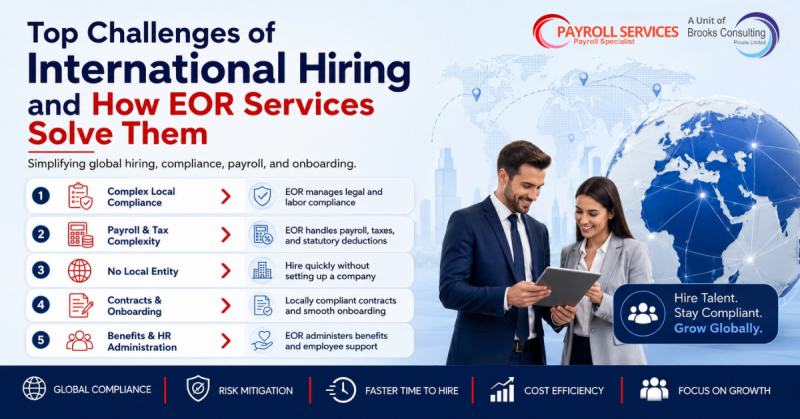
Top Challenges of International Hiring and How EOR Services Solve Them
The Global Talent Revolution: Why International Hiring Is No Longer Optional
The modern workforce has transformed dramatically. Companies are no longer limited by geographical boundaries when searching for top talent. Whether it’s a startup looking for specialized developers, a growing SaaS company seeking multilingual customer support agents, or an enterprise expanding into new markets, international hiring has become a strategic necessity.
Remote work, digital collaboration tools, and globalization have opened access to a worldwide talent pool. It is now possible to hire highly qualified candidates from almost anywhere in the world, sometimes at a competitive rate of pay, and diversify workforces and make them more flexible.
But, while the benefits of hiring internationally are vast, so are the legal, financial, administrative, and compliance challenges. It can be much more complex for organizations to expand their team cross-border than to just post a job online and hold virtual interviews.
International hiring can be a lot to manage, from compliance with labor laws to the intricacies of payroll, tax laws, and employee benefits management. It is here that Employer of Record | EOR services have come into play.
In this comprehensive guide, we’ll explore the biggest challenges of international hiring and explain how EOR services help businesses overcome these obstacles while accelerating global expansion.
What Is an Employer of Record (EOR)?
An Employer of Record | EOR Services is a third party company that acts as an employer for a different company for a different country. The EOR is responsible for all legal matters related to the employment while the client company’s role is to look after the employee’s daily activities, projects and performance.
The Employer of Record assumes responsibility for:
- Employment contracts
- Payroll processing
- Tax compliance
- Benefits administration
- Labor law adherence
- Employee onboarding
- Employment documentation
- HR support
This makes it possible for companies to hire international staff without having to set up a business in each country.
Why International Hiring Is Growing Rapidly
The trend toward global recruitment is on the rise, and there are a number of benefits to it:
Access to Global Talent
Companies can hire the best top candidates regardless of location.
Reduced Talent Shortages
International recruitment is a way to fill skills shortages at the local level.
Cost Optimization
Use of other labor areas can help control wage costs and still keep quality up.
Faster Market Expansion
Local market knowledge and cultural understanding are obtained from the International employees.
Increased Diversity
Different viewpoints and experiences from various global teams drive innovation.
While there are many advantages to international hiring, it also poses certain problems and risks that must be addressed if they are not managed correctly.
Top Challenges of International Hiring and How EOR Services Solve Them
1. Complex Employment Laws and Regulations
The Challenge
Each country has its own labour law regarding:
- Employment contracts
- Working hours
- Overtime regulations
- Paid leave
- Termination procedures
- Employee rights
- Severance requirements
A policy that is perfectly legal in one country may violate labor laws in another.
For example:
- There is a great variation in notice periods between countries.
- Some nations require mandatory bonuses.
- Others have strict employee protection laws.
Failure to comply can result in:
- Financial penalties
- Legal disputes
- Government investigations
- Reputational damage
How EOR Services Solve It
EOR Services providers have local legal expertise in each country in which they operate.
They ensure:
- Employment contracts comply with the local regulations.
- Hiring practices are in line with the laws governing labour.
- Workplace Policy continues to be legally compliant.
- Employees are terminated as per standard procedures.
This decreases significantly legal risk exposure and compliance risk.
2. Establishing Foreign Legal Entities
The Challenge
Traditionally, it was necessary to establish a foreign company in another country to hire employees.
This process often involves:
- Business registration
- Government approvals
- Tax registrations
- Local banking arrangements
- Ongoing compliance obligations
Establish a foreign entity that would cost months and thousands of dollars.
It might not be a viable option for companies that are venturing into new markets.
How EOR Services Solve It
Already a EORs has setup legal persons in several countries.
There are businesses out there which can hire employees at once using the EOR infrastructure without:
- Registering a foreign company
- Managing local bureaucracy
- Handling entity administration
This allows for quick hiring around the world and quick market entry.
3. Global Payroll Management
The Challenge
Processing payroll in multiple countries is a very complex process.
Challenges include:
- Different currencies
- Local tax withholding requirements
- Social security contributions
- Payroll schedules
- Reporting obligations
- Exchange rate fluctuations
Payroll mistakes, no matter how small, can cause big problems for compliance and can lead to employee dissatisfaction.
How EOR Services Solve It
EOR providers handle:
- Accurate payroll calculations
- Currency conversions
- Tax deductions
- Government filings
- Salary disbursements
Employees are paid correctly and on time, and employers escape payroll compliance pitfalls.
4. Tax Compliance Risks
The Challenge
There are a lot of taxes to deal with when hiring internationally.
Organizations must consider:
- Corporate tax exposure
- Payroll taxes
- Employee income taxes
- Social contributions
- Permanent establishment risks
Many companies without realizing it cause tax liabilities for its staff when it hires internationally without the proper legal framework.
How EOR Services Solve It
EORs manage:
- Payroll tax calculations
- Tax reporting
- Local tax compliance
- Regulatory documentation
They possess the knowledge that can help companies reduce risks linked to cross-border taxation issues.
5. Employee Benefits Administration
The Challenge
Expectations of benefits are quite different from country to country.
Employers may be required to provide:
- Health insurance
- Retirement contributions
- Paid parental leave
- Vacation allowances
- Sick leave
- Supplemental benefits
Not offering required benefits can lead to legal repercussions and unhappy workers.
How EOR Services Solve It
EOR companies handle and deliver benefits packages specific to each country, which meet local laws.
They ensure employees receive:
- Statutory benefits
- Competitive compensation packages
- Legally required protections
This is good for attracting and keeping talent.
6.Onboarding International Employees
The Challenge
Multi jurisdictional employee onboarding demands a lot of documentation and compliance.
Companies must manage:
- Employment agreements
- Identity verification
- Tax forms
- Banking information
- Compliance documentation
Without a structured process, onboarding can become slow and inefficient.
How EOR Services Solve It
EORs simplify onboarding procedure.
They handle:
- Employment paperwork
- Compliance checks
- Local documentation requirements
- Employee registration
This will allow them to hire faster and improve the employee experience
7. Employee Misclassification Risks
The Challenge
A large number of companies try hiring foreign nationals as self-employed individuals.
Governments, however, are more and more looking at worker classification.
Misclassification can result in:
- Back taxes
- Fines
- Legal claims
- Employee benefits liabilities
There is variation in how jurisdictions classify.
How EOR Services Solve It
EOR services providers ensure workers are properly classified under local employment laws.
This protects organizations from:
- Regulatory penalties
- Employment disputes
- Compliance violations
8. Data Privacy and Security Compliance
The Challenge
When hiring internationally, there may be an issue of dealing with employee data in different jurisdictions.
Companies must comply with regulations such as:
- GDPR
- Local privacy laws
- Data protection requirements
Not protecting employee information can lead to significant penalties.
How EOR Services Solve It
EORs have compliant data management systems and process in place.
They ensure:
- Secure employee record storage
- Ensuring appropriate data handling procedures are observed.
- Compliance with local privacy regulations
9. Cultural and Language Barriers
The Challenge
Global teams often face:
- Communication challenges
- Language differences
- Cultural misunderstandings
- Different workplace expectations
These factors can impact productivity and employee engagement.
How EOR Services Solve It
A number of EOR companies provide local HR services and knowledge.
They assist to overcome cultural barriers by:
- Local HR guidance
- Country-specific employment practices
- Employee support services
This contributes to better integration of the international workforce
10. Scaling Global Hiring Efficiently
The Challenge
Having employees in different countries can make it more difficult to manage as as the company expands.
Organizations often struggle with:
- Fragmented HR systems
- Multiple vendors
- Inconsistent processes
- Rising administrative costs
How EOR Services Solve It
EOR platforms bring together workforce management in one central place, worldwide.
Companies gain:
- Unified reporting
- Consistent processes
- Simplified administration
- Improved scalability
This frees up HR teams to concentrate their efforts on growth and growth opportunities instead of administrative tasks.
Key Benefits of Using an EOR for International Hiring
By Partnering with an EOR, companies can benefit from:
Faster Hiring
Hire employees in new countries in days, not months.
Reduced Compliance Risk
Remain compliant with local labour and tax laws.
Lower Expansion Costs
Don’t incur high entity setup costs and maintenance fees.
Better Employee Experience
Provide compliant contracts, benefits and payroll support.
Simplified Global Operations
Collaborate with international teams in one place.
Greater Business Agility
Gain access to new markets rapidly and without long-term investment in infrastructure.
Industries Benefiting Most from EOR Services
EOR solutions are particularly useful for:
- Technology companies
- SaaS businesses
- Startups
- Professional services firms
- E-commerce companies
- Healthcare organizations
- Financial services providers
- Consulting firms
- Manufacturing companies
- Remote-first businesses
These sectors often need to hire worldwide skilled candidates quickly and in compliance.
The Future of International Hiring
The acceleration of global hiring is likely to be sustained as companies adopt a remote workforce and distributed teams.
Companies with the ability to attract and retain foreign employees and staff will find that they have the following competitive advantage:
- Broader talent access
- Enhanced innovation
- Market expansion opportunities
- Improved operational flexibility
However, compliance complexity will continue to increase as governments strengthen labor and tax regulations.
In the upcoming years, Employer of Record services will be a key element in helping companies safely and efficiently navigate the changes in this landspace.
Conclusion
International hiring can be a great opportunity for companies looking to grow, innovate, and secure top-tier talent. However, it also comes with a host of compliance, payroll, tax, benefits administration, onboarding and workforce management problems.
Facing these complexities without assistance can place companies in legal jeopardy, financial penalties, and operational inefficiencies.
As a solution to this, employer of record (EOR) services take the burden of local compliance requirements from businesses and serve as a legal employer. This allows businesses to hire overseas with greater self-assurance, minimize administrative complexities, and expedite global growth without creating overseas entities.
With the globalization of the workforce, EOR services are fast emerging as the savvy choice for organizations aiming to establish powerful and efficient international teams without compromising on compliance.
Ready to Expand Your Global Workforce?
Contact Us Today
FAQs
1. What are the biggest challenges of international hiring?
The biggest challenges include compliance with local labor laws, payroll management, tax regulations, employee benefits administration, worker classification, cultural differences, and setting up legal entities in foreign countries.
2. What is an Employer of Record (EOR)?
An Employer of Record (EOR) is a third-party organization that legally employs workers on behalf of a company in another country while handling payroll, taxes, benefits, contracts, and compliance requirements.
3. How does an EOR help with international hiring?
An EOR simplifies international hiring by managing employment contracts, payroll processing, tax compliance, benefits administration, onboarding, and local labor law compliance, allowing businesses to hire globally without establishing local entities.
4. Do I need a legal entity to hire employees internationally?,br>
Most countries require the formation of a local legal entity for direct employment in the country. But, using an EOR Services enables companies to employ staff legally without establishing a foreign subsidiary or branch office.
5. Is using an EOR compliant with local employment laws?
Yes. Reputable EOR providers maintain local legal and HR expertise to ensure employment contracts, payroll processes, benefits, and workforce management comply with country-specific regulations.
6. How does an EOR manage global payroll?
An EOR also manages payroll processing, including salary determination, tax deductions, social security, currency conversion, and salary payments, all with the goal of abiding by local payroll laws and regulations.
7. What are the benefits of using an EOR for global expansion?
Advantages are quick market entry, minimized compliance danger, lower working expenses, streamlined staff management, access to worldwide talent, and better scalability for worldwide growth.
8. Can startups benefit from EOR services?
Yes. For startups, the cost of employing foreign talent could be much higher as they would have to set up a foreign entity, and hiring globally through EOR services would make it more affordable and efficient.
9. How does an EOR reduce worker misclassification risks?
An EOR ensures employees are properly classified according to local labor laws, reducing the risk of penalties, legal disputes, back taxes, and compliance violations.
10. When should a company use an EOR instead of opening a local entity?
An EOR is appropriate for companies looking to expand rapidly, test out markets, hire a few employees abroad, or looking for a more cost-efficient option than setting up a legal entity in another country.