
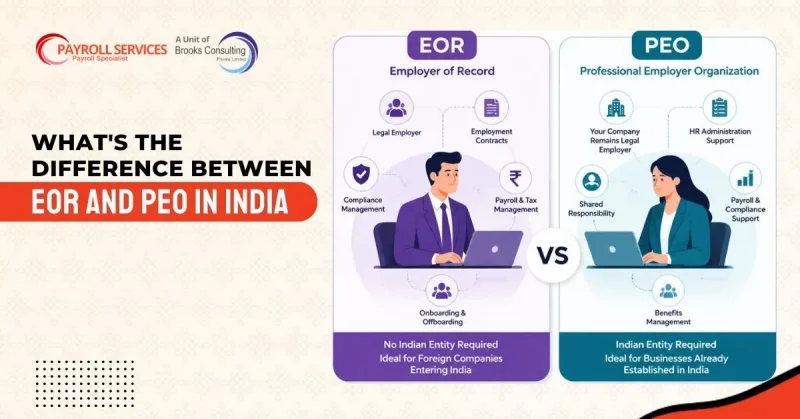
What’s the Difference Between EOR and PEO in India?
As global companies expand into India, managing hiring, payroll, and compliance becomes a major challenge. Two popular workforce solutions that businesses often consider are Employer of Record (EOR) and Professional Employer Organization (PEO) services.
Although both models help companies manage employees and compliance, they operate very differently.
Understanding the difference between EOR and PEO in India is essential before choosing the right solution for your business expansion.
What is an EOR in India?
An Employer of Record (EOR) is a third-party organization that legally employs workers on behalf of your company.
In an EOR model:
- The EOR becomes the legal employer
- Your company manages day-to-day work and operations
- The EOR handles:
- Payroll
- Employment contracts
- PF & ESI compliance
- Tax deductions
- Labour law compliance
- Employee onboarding and offboarding
This model is especially useful for foreign companies that want to hire employees in India without setting up a legal entity.
What is a PEO in India?
A Professional Employer Organization (PEO) operates under a co-employment model.
In a PEO arrangement:
- Your company remains the legal employer
- The PEO manages HR administration and compliance support
- Responsibilities are shared between your company and the PEO
PEO services usually include:
- Payroll processing
- Statutory compliance
- HR administration
- Benefits management
- Employee documentation
Unlike EOR, a PEO generally requires your business to already have a registered entity in India.
Key Difference Between EOR and PEO in India
The biggest difference lies in legal employment responsibility.
| Feature | EOR | PEO |
| Legal employer | EOR provider | Your company |
| Requires Indian entity | No | Yes |
| Employment model | Full employment outsourcing | Co-employment |
| Compliance responsibility | Fully managed by EOR | Shared responsibility |
| Best for | Foreign companies entering India | Businesses with Indian entity |
When Should You Choose an EOR in India?
An EOR is ideal if:
✔ You do not have a legal entity in India
✔ You want to hire employees quickly
✔ You are testing the Indian market
✔ You want full compliance support
✔ You want to avoid entity setup costs
Example:
A US-based SaaS company wants to hire 5 developers in India without opening an Indian subsidiary. An EOR allows them to legally hire employees within days.
When Should You Choose a PEO in India?
A PEO is suitable if:
✔ You already have a registered company in India
✔ You want to outsource HR and payroll functions
✔ You need compliance and administrative support
✔ You are scaling your workforce rapidly
Example:
A manufacturing company with an Indian entity uses a PEO to manage payroll and statutory compliance across multiple states.
Advantages of EOR in India
1. No Need for Entity Setup
An EOR allows foreign companies to hire in India without:
- Company registration
- Tax registrations
- Setting up local infrastructure
2. Faster Market Entry
Employees can often be onboarded within days instead of months.
3. Reduced Compliance Risk
The EOR handles:
- Labour law compliance
- Payroll filings
- Statutory deductions
This significantly reduces legal risk.
4. Lower Administrative Burden
Your company can focus on growth while the EOR manages HR operations.
Advantages of PEO in India
1. HR & Payroll Expertise
PEO providers help streamline:
- Payroll
- Benefits
- Compliance
- HR documentation
2. Cost Efficiency
PEO services can reduce the cost of maintaining a large internal HR department.
3. Better Workforce Management
PEOs help companies scale operations efficiently.
Limitations of EOR
- Per-employee costs may be higher for large teams
- Less direct control over HR administration
- Not ideal for very large long-term operations
Limitations of PEO
- Requires Indian legal entity
- Shared compliance responsibility
- Co-employment structure may create operational complexity
EOR vs PEO: Which is Better for Foreign Companies?
For foreign companies entering India for the first time:
👉 EOR is usually the better option.
Why?
- No entity setup required
- Faster hiring
- Full compliance handling
- Lower operational complexity
For companies already established in India:
👉 PEO may be more cost-effective for workforce management.
Cost Comparison: EOR vs PEO
| Factor | EOR | PEO |
| Entity setup required | No | Yes |
| Compliance management | Included | Shared |
| HR management | Included | Partial |
| Typical use case | Market entry | Workforce optimization |
Generally:
- EOR costs are higher per employee
- PEO becomes economical for larger teams
How to Choose Between EOR and PEO in India
Before deciding, ask:
- Do you have an Indian entity?
- How quickly do you want to hire?
- How many employees are you planning to hire?
- Do you want full compliance outsourcing?
- What is your long-term expansion plan?
Your answers will determine the right model.
Final Thoughts
Both EOR and PEO services offer valuable solutions for businesses expanding into India.
Choose EOR if:
✔ You want to hire in India without legal entity
✔ You need rapid expansion
✔ You want complete compliance support
Choose PEO if:
✔ You already have an Indian entity
✔ You need HR and payroll assistance
✔ You want to optimize workforce management
Understanding the difference between EOR and PEO helps businesses make smarter expansion decisions while reducing compliance and operational risks.
FAQ Section (For SEO)
1. What is the main difference between EOR and PEO?
EOR becomes the legal employer, while PEO operates under a co-employment model.
2. Does a PEO require an Indian entity?
Yes, businesses generally need a registered entity in India to use PEO services.
3. Can foreign companies use EOR in India?
Yes, EOR is one of the best solutions for foreign companies hiring in India.
4. Is EOR more expensive than PEO?
Usually yes, but EOR eliminates entity setup and compliance management costs.
5. Which is better for startups entering India?
EOR is typically better for startups testing the Indian market.