
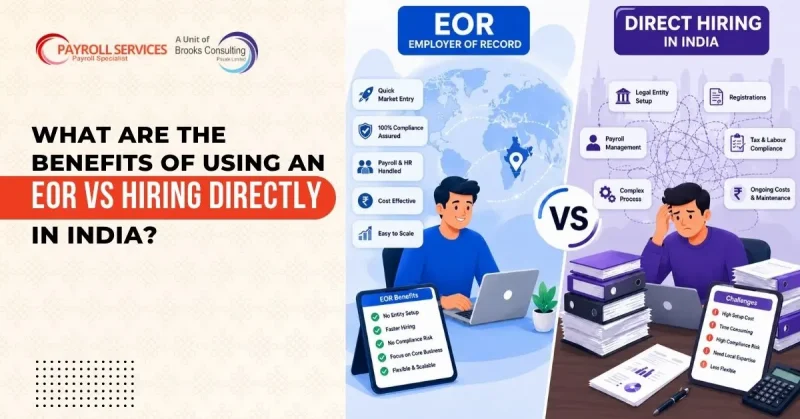
What Are the Benefits of Using an EOR vs Hiring Directly in India?
India has become one of the world’s most attractive destinations for global hiring. With access to highly skilled professionals, competitive operational costs, and a growing digital economy, many international companies are looking to expand their workforce in India.
However, one critical decision businesses face is:
Should you hire employees directly in India or use an Employer of Record (EOR)?
While direct hiring may seem straightforward, it often involves legal, payroll, and compliance complexities that foreign companies underestimate. An EOR solution can simplify expansion and reduce operational risk significantly.
In this guide, we’ll explore the major benefits of using an EOR versus hiring directly in India.
What is an Employer of Record (EOR)?
An Employer of Record (EOR) is a third-party organization that legally employs workers on behalf of your company.
The EOR handles:
- Employment contracts
- Payroll processing
- PF & ESI compliance
- Tax deductions
- Labour law compliance
- Employee onboarding and offboarding
Meanwhile, your company manages:
- Daily work
- Performance
- Business operations
What Does Direct Hiring in India Mean?
Direct hiring means your company:
- Sets up a legal entity in India
- Registers for tax and labour compliance
- Manages payroll internally
- Handles employment contracts
- Takes full responsibility for statutory compliance
While this gives more control, it also creates significant administrative and legal responsibilities.
Key Benefits of Using an EOR in India
1. No Need to Set Up a Legal Entity
One of the biggest advantages of an EOR is that you can hire employees in India without establishing a company.
Direct hiring requires:
- Company incorporation
- PAN/TAN registration
- GST registration (if applicable)
- Labour registrations
- Bank account setup
This process can take weeks or even months.
With an EOR:
✔ You can start hiring almost immediately.
2. Faster Market Entry
Speed matters when entering a new market.
Using an EOR allows businesses to:
- Hire employees quickly
- Launch operations faster
- Test the Indian market without long-term commitments
In many cases, onboarding can happen within days instead of months.
3. Reduced Compliance Risk
India has complex labour laws and compliance requirements, including:
- Provident Fund (PF)
- Employee State Insurance (ESI)
- Professional Tax
- TDS deductions
- Gratuity regulations
- State-specific labour laws
When hiring directly, your company becomes fully responsible for compliance.
An EOR helps reduce this burden by managing:
✔ Payroll compliance
✔ Labour law filings
✔ Statutory contributions
✔ Employment documentation
This significantly lowers legal risk.
4. Lower Administrative Burden
Managing payroll and HR internally requires:
- HR staff
- Payroll software
- Compliance experts
- Legal consultants
An EOR centralizes these functions under one provider.
This allows your business to focus on:
- Growth
- Product development
- Sales and operations
5. Cost Efficiency for Small & Mid-Sized Teams
Setting up an entity in India involves:
- Legal costs
- Accounting costs
- Compliance costs
- Office infrastructure
- HR team expenses
For companies hiring only a few employees initially, these costs may not be practical.
An EOR offers a more flexible and cost-effective alternative.
6. Easier Multi-State Hiring
India has different labour regulations across states.
Direct hiring across multiple states can become highly complex.
An experienced EOR can manage:
✔ State-specific compliance
✔ Local payroll regulations
✔ Multi-location hiring
This simplifies workforce expansion.
7. Better Scalability
An EOR makes scaling easier because:
- New employees can be onboarded quickly
- HR infrastructure is already in place
- Payroll systems are standardized
Whether hiring 2 employees or 50, expansion becomes smoother.
8. Simplified Employee Onboarding & Offboarding
An EOR handles:
- Offer letters
- Employment agreements
- Full & final settlements
- Exit documentation
This creates a professional employee experience while reducing internal workload.
Challenges of Hiring Directly in India
While direct hiring offers full control, it also comes with challenges.
Complex Compliance Requirements
Labour laws in India frequently change and vary across states.
Non-compliance can lead to:
- Penalties
- Legal disputes
- Operational delays
Higher Setup Costs
Entity formation and ongoing maintenance can be expensive for smaller teams.
Longer Hiring Timelines
Before hiring directly, companies must complete:
- Registrations
- Tax setup
- Banking formalities
- Compliance infrastructure
This delays expansion.
Need for Internal HR Expertise
Direct hiring requires strong local HR and payroll knowledge.
When Should You Choose an EOR Instead of Direct Hiring?
Using an EOR is ideal if:
✔ You do not have an Indian entity
✔ You want to hire quickly
✔ You are testing the Indian market
✔ You want minimal compliance risk
✔ You need operational flexibility
When Does Direct Hiring Make Sense?
Direct hiring may be suitable if:
✔ You plan long-term operations in India
✔ You are hiring a large workforce
✔ You want complete operational control
✔ You already have local HR infrastructure
EOR vs Direct Hiring: Quick Comparison
| Factor | EOR | Direct Hiring |
| Requires Indian entity | No | Yes |
| Compliance management | Handled by EOR | Managed internally |
| Time to hire | Fast | Slower |
| HR infrastructure needed | Minimal | Significant |
| Best for | Market entry & scaling | Long-term operations |
Final Thoughts
Choosing between an EOR and direct hiring in India depends on your business goals, expansion plans, and operational readiness.
For many global businesses, an EOR provides:
✔ Faster hiring
✔ Reduced compliance risk
✔ Lower administrative burden
✔ Cost-effective market entry
✔ Flexible workforce scaling
If your goal is to expand into India quickly and compliantly, an EOR is often the smartest and safest solution.
FAQ Section
1. What is the biggest advantage of using an EOR in India?
The ability to hire employees legally without setting up a local entity.
2. Is using an EOR cheaper than direct hiring?
For small and mid-sized teams, yes — especially when considering entity setup and compliance costs.
3. Can an EOR handle payroll compliance in India?
Yes, EOR providers manage payroll, PF, ESI, tax deductions, and labour law compliance.
4. Is direct hiring better for large companies?
Direct hiring may become more cost-effective for large long-term operations.
5. Can foreign companies legally hire through an EOR in India?
Yes, EOR services are widely used for compliant hiring in India.