
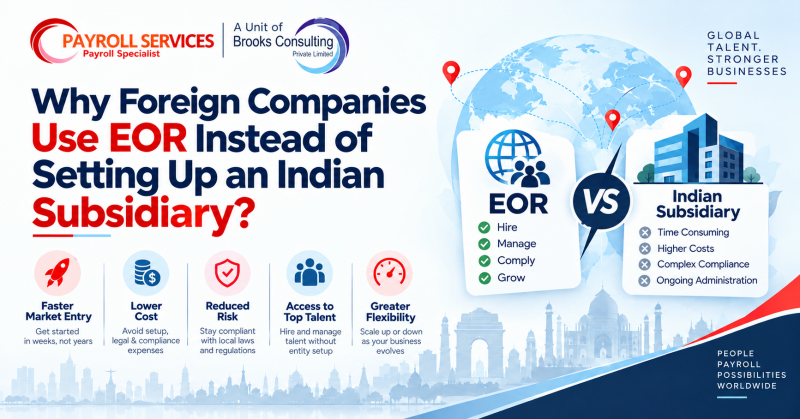
Why Foreign Companies Use EOR Instead of Setting Up an Indian Subsidiary
Expanding into India can unlock access to one of the world’s largest talent pools, rapidly growing consumer markets and skilled professionals await expansion into India. However, for foreign companies, it is not necessarily easy to get into the Indian market by simply hiring an employee and getting up and running.
Creating an Indian subsidiary may include company incorporation, registrations with various government agencies, tax compliance, and employment laws, payroll procedures, accounting, banking and other statutory requirements. This can lead to unnecessary complexity and cost for companies that are just trying to test the market in India or want to hire talent but aren’t ready to make a permanent legal investment.
That is where an Employer of Record (EOR) in India becomes a strategic alternative.
EOR enables foreign companies to employ and manage employees in India without creating a subsidiaries in India. The EOR is the legal employer of the employee and the foreign company remains responsible for the employee’s day-to-day activities, their performance, and their business goals.
An EOR can make expansion into India a much smoother process if it is a faster, more flexible and less risky option for companies looking to expand their India footprint.
What Is an Employer of Record (EOR) in India?
An Employer of Record (EOR) is a third party organization that is legally responsible for the employment of people on behalf of another company.
The foreign company is still accountable for the employee’s role, responsibilities, performance, and work on a day-to-day basis. At the same time the EOR takes care of the legal and administrative aspects of the employment, including:
- Employment contracts
- Payroll processing
- Salary payments
- Tax withholding
- Statutory contributions
- Employee benefits administration
- Leave and attendance compliance
- Employment documentation
- Local labor-law compliance
- Employee onboarding and offboarding
This agreement enables foreign companies to assemble a team in India without having to first establish an Indian entity.
Why Do Foreign Companies Choose EOR in India?
There’s a very simple reason why companies opt for an EOR: they want to hire in India without having to set up and manage a subsidiary.
For businesses with a long-term presence in India with a strong business case, an Indian subsidiary might be a great idea. If the goal is to hire a few staff, test a market, establish a remote workforce, or get access to specialized talent, though, it may be more infrastructure than the company needs.
An EOR makes it much more straightforward to access the Indian employment market.
Considering all these points, foreign companies prefer to work with EOR rather than establish an Indian subsidiary.
1. Faster Market Entry
The process of establishing a legal entity can be time consuming, especially if one is incorporating, registering, opening a bank account, filling out tax forms, setting up payroll systems, as well as other legal requirements.
Much of this infrastructure is already in place with an EOR.
A company can get Indian employees on board much faster than it would take to build an employment structure, depending on the EOR provider and the needs of the employee.
Why speed matters
Speed can be especially important when:
- The company requires specialized skills on the spot.
- A project has to be done within a limited time period.
- The business is looking to expand its business in the Indian market.
- A start-up company is going global.
- A remote team is starting up in a company.
- Competitors have already recruited local talent.
The faster a company can receive the right staff in its doors, the sooner it can create business value.
2. No Need to Establish an Indian Subsidiary
One of the most attractive benefits of an EOR is that the foreign company doesn’t have to establish a separate subsidiary in India to hire local employees.
The EOR has already established an adequate employment system locally.
This can eliminate the need for the foreign company to immediately manage:
- Entity incorporation
- Local employment infrastructure
- Payroll setup
- Employer registrations
- Local HR administration
- Statutory payroll processes
- Ongoing employment compliance
This may be more feasible for small Indian businesses than establishing their own separate firm.
‘3. Lower Upfront Costs
The incorporation fees are just the beginning of establishing an Indian subsidiary.
Companies may also need to budget for:
- Professional legal services
- Accounting services
- Tax advisory
- Payroll systems
- HR administration
- Office infrastructure
- Compliance support
- Banking and financial administration
- Company-secretarial requirements
- Ongoing regulatory filings
These service requirements are transformed into a more reliable service cost by an EOR.
This makes EOR an ideal option for businesses looking to manage expenses associated with expansion and validate their presence in India.
4. Simplified Payroll Management
There are several statutory and regulatory obligations involved in Indian payroll.
The EOR can also handle all the administration of payroll for the foreign company, such as salary processing and deductions and contributions required by the local laws.
This means that the foreign company doesn’t need to establish a payroll system within India and manage it on their own.
This can ease the administrative burden for HR teams working with international employees in India, where they may not be accustomed to the country’s employment and payroll laws.
5. Help With Indian Employment Compliance
There are wide differences across countries in terms of the regulations governing employment.
A company that has practiced its employment process in the United States, United Kingdom, Europe, Singapore or another market may not necessarily be aware of all the requirements in employing individuals in India.
An EOR can assist in the management of local employment obligations, including such areas as:
- Employment contracts
- Statutory deductions
- Payroll compliance
- Leave requirements
- Employee benefits
- Termination procedures
- Required employment documentation
- Applicable labor regulations
This can help alleviate the chances of administrative errors.
Important: The EORs vary in terms of what they cover and how they are structured; therefore, companies need to do the necessary due diligence before choosing an EOR.
6. Access to Indian Talent Without a Permanent Commitment
Some of the greatest advantages of an EOR is flexibility.
A company might consider employing Indian personnel but might not be sure of their future plans for a permanent presence in India.
An EOR gives the company a chance to “test the waters.
For example, a technology company could hire:
- Software developers
- Data scientists
- Product managers
- Customer-support professionals
- Sales representatives
- Finance professionals
- Marketing specialists
The company can also grow its workforce first, and ensure that setting up an Indian subsidiary is a strategic fit later.
7. Ideal for Remote and Distributed Teams
People around the world are working in more widely dispersed workforces.
A company can be based in the USA, managed in Europe, have Indian developers, and customers across various countries.
Establishing a legal entity each time they hire in a new country can be inefficient for these businesses.
An EOR enables companies to establish international teams and consolidate a lot of HR and employment administration.
This is particularly useful for:
- Remote-first companies
- SaaS companies
- Technology startups
- Consulting businesses
- Professional-services firms
- Global agencies
- Venture-backed startups
8. Easier Employee Onboarding
The process of hiring an international employee is not as simple as finding the right person.
The employee should also have a valid legal contract, documented, onboarded and paid properly.
An EOR can facilitate this process by offering the local employment infrastructure.
Rather than building an Indian HR system before hiring the first person, the foreign company can leverage the EOR’s system and processes.
This makes it easier for an employer and employee.
9. Reduced Administrative Burden
In the case of a subsidiary, the company operates its Indian subsidiary.
This leaves continuous administrative tasks.
Many of the administrative aspects of an employment relationship are managed by the EOR with an EOR.
The foreign company can thus be more focused on:
- Hiring
- Product development
- Sales
- Customer acquisition
- Business strategy
- Team management
- Market expansion
Instead of devoting substantial in-house resources to employment administration.
EOR vs Indian Subsidiary: What’s the Difference?
The right option will rely on the company’s future goals.
EORs are more appropriate for businesses looking to hire workers in India without assuming a legal presence in the country.
An Indian subsidiary may be more suitable for those companies that plan to have a significant long-term presence in India.
| Factor | EOR in India | Indian Subsidiary |
| Legal entity required by foreign company | Generally no | Yes |
| Speed of hiring | Faster | Typically slower |
| Upfront setup | Lower | Higher |
| Payroll administration | Managed by EOR | Managed by company/partners |
| Employment compliance | Supported by EOR | Company’s responsibility |
| Market testing | Excellent fit | Less flexible |
| Long-term local operations | May be suitable | Often better |
| Administrative responsibility | Lower | Higher |
| Control over local entity | Limited | Greater |
| Ideal for small teams | Yes | May be excessive |
| Ideal for substantial operations | Depends on needs | Often yes |
When Should a Company Choose an EOR?
An EOR might be a more suitable option if an organization:
- Wants to recruit employees in India quickly
- Has a small Indian team
- Wants to test the Indian market
- Initially, they are entering into India for the first time.
- Does not want to immediately set up an entity for itself
- Needs specialized Indian talent
- Operates remotely
- Wants to reduce HR administration
- Is uncertain about its long-term Indian presence
- Wants a flexible international hiring strategy
When Should a Company Set Up an Indian Subsidiary?
A subsidiary may be more appropriate in situations where the company:
- Plans significant long-term operations in India
- Expects to employ a large local workforce
- “Requires a committed local corporate presence”
- Is aware of and intends significant local business activity
- Desires more control over its Indian subsidiary
- Needs local infrastructure to operate businesses
- Believes that India will be a key strategic market
That is, it is not a decision that is made once and for all: EOR vs subsidiary.
For many companies, it can be:
EOR first → validate the market → build the team → establish a subsidiary when the business case becomes strong enough.
The Biggest Benefits of Using an EOR in India
The strategic benefits of an EOR go beyond payroll.
Faster expansion
The companies can start filling their Indian workforces without having to establish a complete local employment system first.
Greater flexibility
Companies can grow, shrink or reorganize their overseas workforce without having to make an immediate decision on the formation of a permanent presence overseas.
Reduced administrative complexity
Many HR, financial and legal duties within the company are delegated to the EOR, who will perform them on the HR’s behalf.
Access to specialized talent
There are many professionals in technology, engineering, finance, customer service, design, analytics, and more who are available in India.
Better focus on core business
International firms can concentrate on expanding their business rather than getting experts at employment administration in the local market.
Is an EOR Cheaper Than an Indian Subsidiary?
This is dependent on company size, hiring volume, the nature of the company’s business and its long-term plans.
Typically, an EOR will charge an ongoing fee in addition to the cost of the employees. A subsidiary, on the other hand, has setup costs and administrative, accounting, tax, legal, payroll and compliance duties.
An EOR might be better suited for a company that has just a few employees as there is no need to invest in the infrastructure to keep up a separate business entity.
After some time, it may become economically and strategically advantageous for a large organisation with hundreds of employees to form its own organisation.
The key question isn’t simply:
“Which option has the lowest fee?”
It is:
“What is the most cost and time efficient, compliant, flexible and strategic structure for our current stage?”
How Does an EOR Work in India?
The process is fairly simple.
1: Identify the talent
The foreign company finds and selects the Indian candidate.
2: Engage an EOR provider
The company selects an EOR having the proper infrastructure and compliance requirements for the country.
3: Employment agreement
The worker is in the right employment contract with the EOR.
4: Employee onboarding
The EOR collects required documentation and completes onboarding procedures.
5: Payroll and statutory administration
The EOR handles payroll and relevant to employment compliance processes.
6: Employee works for the foreign company
The employee carries out their work as per the instruction of the foreign company.
7: Ongoing HR administration
The EOR provides administrative support for the employees’ employment.
EOR for Startups Expanding Into India
Speed and capital efficiency are very important for startups.
A startup might find a very good Indian developer or salesperson, but be reluctant to hire due to lack of a legal entity in India.
An EOR eliminates a lot of that first hurdle.
The startup can create its Indian team without waiting to create a local structure.
This can be especially beneficial for startups and ventures funded by venture capitalists who wish to expand their businesses overseas and maintain their slim operating structure.
EOR for Global Companies Hiring Indian Employees
EOR solutions can be useful to large multinational companies as well.
An enterprise might have an operations that spans several countries but desire to have a uniform approach to hiring in new countries.
An EOR can offer HR services support in the local area, while also enabling the company’s HR and financial teams to have centralized processes.
This can enable the organization scale up hiring internationally but not develop a separate operational model for each country.
Potential Limitations of an EOR
While EOR services offer many advantages, they aren’t a suitable choice for every business.
Companies should consider:
- EOR service fees
- The level of control over the employment structure
- Provider reliability
- Data security
- Employee benefits
- Compliance processes
- Contractual limitations
- Intellectual-property arrangements
- Termination procedures
- Long-term scalability
For the companies with significant business operations, it may be beneficial to form a subsidiary in India eventually for gaining strategic control over the company.
Ideally, the EOR model should be compared to the company’s anticipated number of employees, business operations, investment timeline, and regulatory needs.
How to Choose the Best EOR Provider in India
The selection of the right EOR partner is of utmost importance.
Before signing an agreement, evaluate:
1. Local expertise
Select a provider with great strong expertise of Indian employment and payroll requirements.
2. Compliance capabilities
Discuss with the provider how they conduct payroll, statutory requirements, employment documentation and how they deal with regulation changes.
3. Transparent pricing
Know exactly what is covered in the EOR fee and what services are available on top of the base fee.
4. Employee support
A good EOR should provide responsive support to employees as well as the client company.
5. Technology
Research systems which allow easy to manage onboarding, payroll, documentation, leave management and reporting.
6. Data security
Information about employees is confidential. Assess the security measures and data management of the provider.
7. Scalability
Your provider should be able to help you from your initial hire of Indians up to the growth of your company.
8. Exit flexibility
Be aware of the consequences of doing so in the future if you want to set up your own Indian subsidiary or relocate employees to another employment structure.
Conclusion: Why EOR Is Becoming a Strategic Expansion Tool
India offers vast opportunities for international enterprises, but this does not imply that foreign companies have to set up a subsidiary immediately to establish operations in the country.
In the event that an international organization needs to hire people locally, recruit staff locally, test the market, or continue its international expansion without excessive administrative hassle, an Employer of Record can serve this purpose.
The biggest advantage isn’t simply convenience.
It’s flexibility.
An EOR enables businesses to dip their toes into the employment market before making significant structural investments when it’s clear that the business case has landed.
This might be the first 5 staff members for a start-up company.
If you’re a global enterprise, it might involve creating a full-fledged remote department.
It might mean trying out India today and setting-up a subsidiary tomorrow for a growing company.
Choosing the right employment model will depend on the objectives, the size of the workforce, the business type, and strategic goals for expansion.
Ready to Hire in India Without Setting Up a Subsidiary?
Talk to our India EOR experts today
FAQs | EOR in India
1. Can a foreign company hire employees in India without an Indian subsidiary?
Yes, a foreign business can hire a workforce in India without establishing an Indian subsidiary (if appropriate to the client company) and a foreign EOR can typically take care of contract matters, payroll, statutory deductions, benefits administration, and other employment matters required by the country, depending on the specifics of the client company, employees, and compliance requirements, as well as what the EOR provides. EOR arrangements are, however, typically structured to speed up international legal and regulatory conditions of the arrangement.
2. What does an EOR do in India?
An EOR becomes the legal employer of employees on behalf of a client company and often is responsible for administrative tasks relating to employment including contracts, payroll, statutory deductions, administering benefits, and other local employment-related matters.
3. Is an EOR the same as a subsidiary?
No. EOR and a subsidiary are two entities with different structures. An EOR is a third-party employment arrangement, a subsidiary is a company that is created and managed by the foreign parent company.
4. How quickly can a foreign company hire through an EOR?
The time frame is different, depending on the provider, employee documentation, role and compliance requirements. Most EOR providers, however, are specifically created to speed up the process for international hiring, as opposed to creating a new legal entity from the ground up.
5. Is EOR suitable for startups?
Yes. A major advantage of EOR services is that they can facilitate the recruitment of Indian staff for startups without the hassle and expense of forming a subsidiary before proving successful in the market.
6. Can I move from an EOR to an Indian subsidiary later?
Potentially, yes. When the business expands in India, an international company can switch from an EOR structure to its own local entity with careful consideration and proper legal structuring, but this journey provides numerous opportunities for international companies—but don’t enter the country unless you’re ready to establish your own entity, tax, employment, and compliance advice.