
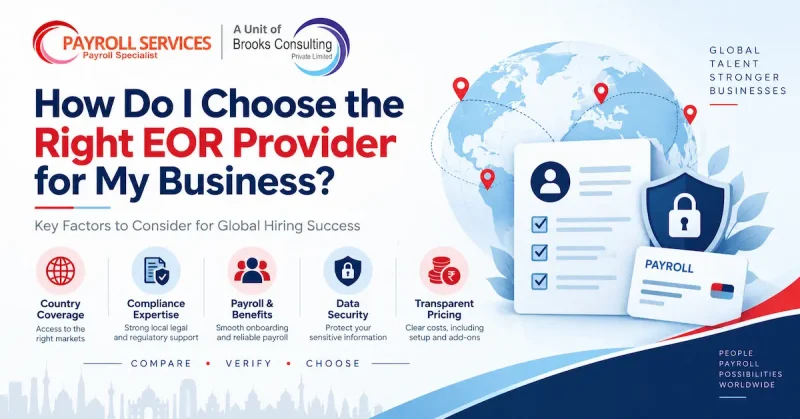
How Do I Choose the Right EOR Provider for My Business?
Expanding into a new country can create exciting opportunities for a business, but hiring employees internationally also involves payroll, employment contracts, tax requirements, statutory compliance, benefits, and HR administration. An Employer of Record (EOR) can help businesses manage these responsibilities without establishing their own legal entity in the country.
However, choosing the right EOR provider is an important decision. Different providers may offer different levels of compliance support, payroll management, employee benefits, technology, customer service, and international coverage.
So, how do you choose the right EOR provider for your business?
The answer depends on your hiring plans, target country, workforce size, compliance requirements, budget, and the level of HR support you need.
What Is an EOR Provider?
An Employer of Record provider is a third-party organization that legally employs workers on behalf of another company in a particular country.
The EOR generally manages responsibilities such as:
- Employment contracts
- Payroll processing
- Statutory deductions
- Tax-related payroll administration
- Employee benefits
- Onboarding and offboarding
- Employment documentation
- Local employment compliance
- HR administration
Your business typically continues to manage the employee’s day-to-day work, responsibilities, performance, and reporting, while the EOR handles the local employment administration.
For companies hiring employees in India, an EOR can provide a way to employ workers while reducing the need to immediately establish a separate Indian legal entity.
Why Does Choosing the Right EOR Provider Matter?
An EOR becomes closely involved with your employees’ employment administration and compliance requirements. Therefore, selecting a provider only because it offers the lowest monthly fee may not be the best approach.
The right provider should be able to support your business with:
- Reliable payroll processing
- Accurate statutory compliance
- Proper employment documentation
- Transparent pricing
- Timely employee support
- Secure handling of employee information
- Efficient onboarding and offboarding
- Knowledge of local employment requirements
- Scalable HR administration
A provider that fits a startup hiring two employees may not necessarily be suitable for an international company planning to hire hundreds of employees.
1. Check the Provider’s Experience in Your Target Country
The first question to ask is whether the EOR provider has meaningful experience in the country where you plan to hire.
Employment regulations differ from country to country. If you are hiring in India, for example, the provider should understand the applicable employment, payroll, tax, and statutory requirements relevant to your workforce.
Ask the provider:
- How long have you operated in the country?
- How many employees do you currently support?
- Do you have local payroll expertise?
- How do you handle statutory compliance?
- What industries do you support?
- Can you provide references or relevant case studies?
Country-specific expertise is particularly important when your business is entering a market for the first time.
2. Understand Whether the EOR Is a Direct Employer or Uses Partners
One important question is how the EOR actually delivers its service.
Some providers operate through their own entities in different countries, while others may use local partners or networks.
Ask:
“Will your company directly employ our workers in the target country, or will another organization act as the local employer?”
Understanding this structure can help you evaluate accountability, communication, compliance management, and the overall employee experience.
For businesses hiring in India, clarify exactly which legal entity will employ the workers and who will be responsible for employment administration.
3. Review Payroll and Compliance Capabilities
Payroll is one of the most important responsibilities handled by an EOR.
Before signing a contract, understand how the provider manages:
- Salary calculations
- Payroll processing
- Statutory deductions
- Tax-related payroll requirements
- Employee reimbursements
- Payslips
- Payroll reporting
- Benefits administration
- Final settlements
Also ask how payroll errors are handled.
A good EOR provider should have established processes for reviewing payroll information and addressing discrepancies quickly.
4. Examine Employment Compliance Support
International employment involves more than paying salaries.
An EOR may need to manage various employment-related requirements, including contracts, statutory benefits, leave administration, employee records, termination procedures, and other local obligations.
Ask the provider:
- Who monitors regulatory changes?
- How are employment contracts prepared?
- How are statutory changes communicated?
- Who handles employee documentation?
- What happens when employment regulations change?
For companies expanding into India, local compliance knowledge can be especially valuable because employment and payroll requirements can involve multiple statutory considerations.
5. Compare the Total Cost, Not Just the Monthly EOR Fee
Price is important, but the cheapest EOR provider is not necessarily the lowest-cost option overall.
Ask for a complete pricing breakdown.
Potential costs can include:
- EOR management fee
- Employee onboarding fee
- Payroll processing fee
- Benefits administration
- Expense management
- Offboarding fees
- Currency conversion charges
- Additional HR services
- Special compliance services
For example, a provider may advertise a low base fee but charge additional amounts for services your business actually requires.
Request a detailed quotation and ask:
“What costs are included in the standard EOR fee, and what services are charged separately?”
This makes it easier to compare providers accurately.
6. Evaluate Employee Benefits
Employee benefits can have an important impact on recruitment and retention.
Depending on the country and employment arrangement, an EOR may support benefits such as:
- Health insurance
- Retirement or statutory benefits
- Paid leave
- Allowances
- Additional employee benefits
- Local benefits administration
Ask what benefits are available, which are mandatory, which are optional, and how much they cost.
If you are hiring in India, make sure the provider can explain the benefits and statutory components relevant to your employees clearly.
7. Look at the Technology and Payroll Platform
Technology can make EOR administration considerably easier.
Ask whether the provider offers an online platform where your HR or finance team can:
- Add employees
- View payroll information
- Access payslips
- Approve expenses
- Manage documents
- Track onboarding
- View reports
- Submit HR requests
Also consider the quality of reporting.
If your finance team needs payroll data for accounting and budgeting, the ability to generate accurate and useful reports can save significant administrative time.
8 Assess Customer Support
EOR services involve employees, payroll, compliance, and sensitive employment matters. Therefore, customer support is an important consideration.
Find out:
- Who will be your account manager?
- Is support available by email, phone, or chat?
- What are the response times?
- Is local support available?
- Who handles employee queries?
- How are urgent payroll issues escalated?
A provider may have excellent software, but responsive human support can still be essential when dealing with payroll or employment issues.
9. Check Data Security and Privacy Practices
EOR providers handle sensitive employee information, including personal details, payroll information, bank information, and employment documents.
Before selecting a provider, ask about:
- Data security
- Access controls
- Data storage
- Privacy policies
- Employee information protection
- Security certifications, where applicable
- Data breach procedures
Your organization should understand how employee data is collected, stored, processed, and shared.
10. Consider Scalability
Your EOR requirements may change as your business grows.
You may start with five employees and later expand to 50 or 500 employees.
Ask:
“Can you support us if our workforce increases significantly?”
Also determine whether the provider can support:
- Multiple locations
- Multiple departments
- Different employee types
- Rapid hiring
- Large payroll volumes
- Additional HR requirements
Scalability is especially important for startups and international companies entering new markets.
11. Check the Onboarding and Offboarding Process
The employee experience begins before the first salary is paid.
Ask the provider to explain the complete onboarding process.
This may include:
- Employee information collection
- Employment contract preparation
- Document verification
- Employee onboarding
- Payroll setup
- Benefits enrollment
- First payroll processing
You should also understand the offboarding process, including notice periods, final settlements, documentation, and other applicable requirements.
A clearly documented process can reduce delays and administrative problems.
12. Ask About Contract Flexibility
Before signing, carefully review the EOR agreement.
Pay attention to:
- Contract duration
- Notice periods
- Termination provisions
- Replacement provisions
- Liability
- Indemnification
- Payment terms
- Additional charges
- Data protection
- Service-level commitments
If anything is unclear, ask the provider to explain it before signing.
Your legal or professional advisers can also review the agreement where appropriate.
13. Read Reviews and Ask for References
Online reviews can provide useful information, but don’t rely on reviews alone.
If possible, ask the provider for relevant client references or case studies.
Try to find businesses with similar requirements:
- Similar company size
- Similar industry
- Similar target country
- Similar number of employees
- Similar international expansion plans
Ask references about:
- Payroll accuracy
- Responsiveness
- Employee support
- Compliance management
- Billing transparency
- Onboarding experience
This can provide a more practical understanding of what it is like to work with the provider.
14. Ask These Questions Before Selecting an EOR
Before making a decision, prepare a checklist of questions.
EOR Provider Checklist
Experience
- How long have you provided EOR services?
- How many employees do you manage?
- Do you specialize in particular industries?
Country Coverage
- Do you directly operate in our target country?
- Who will legally employ our employees?
Payroll
- How is payroll processed?
- What payroll reports are provided?
- How are payroll errors handled?
Compliance
- Who monitors regulatory changes?
- How are statutory requirements managed?
Benefits
- What employee benefits are available?
- Which benefits are included in the quoted price?
Technology
- Do you provide a payroll and HR platform?
- Can our HR and finance teams access reports?
Support
- Will we have a dedicated account manager?
- What is the expected response time?
Pricing
- What is included in the monthly fee?
- Are there onboarding or offboarding charges?
- Are there any additional fees?
Scalability
- Can you support us as our workforce grows?
15. Create a Simple EOR Comparison Framework
Instead of comparing providers based on price alone, evaluate them across several areas.
| Factor | Questions to Consider |
| Country expertise | Does the provider understand local employment requirements? |
| Legal employment | Who actually employs the workers? |
| Payroll | Is payroll accurate and reliable? |
| Compliance | How are regulatory obligations managed? |
| Pricing | Are fees transparent? |
| Benefits | Are suitable employee benefits available? |
| Technology | Is the platform easy to use? |
| Support | Is customer and employee support responsive? |
| Security | How is employee data protected? |
| Scalability | Can the provider support future growth? |
| Onboarding | Is the process straightforward? |
| Offboarding | Are exits handled efficiently? |
This framework can help your HR, finance, and management teams compare providers using the requirements that matter to your organization.
EOR Provider vs Building Your Own Local Entity
Another consideration is whether an EOR is actually the right solution for your expansion plans.
If you only need to hire a small number of employees in a new country, establishing a local entity may involve significant administrative work.
An EOR can potentially simplify the process by handling local employment administration.
However, if you plan to build a large long-term operation in a country, establishing your own entity may eventually become part of your expansion strategy.
The appropriate approach depends on factors such as:
- Number of employees
- Expected growth
- Duration of operations
- Business structure
- Compliance requirements
- Budget
- Long-term expansion plans
Final Thoughts
Choosing the right EOR provider requires more than comparing monthly prices.
Businesses should evaluate country expertise, legal employment structure, payroll capabilities, compliance support, employee benefits, technology, customer service, data security, pricing transparency, and scalability.
If your company is planning to hire employees in India, working with an experienced EOR provider in India can help simplify employment administration and allow your team to focus more on business operations and growth.
Before selecting a provider, request a detailed proposal, understand the complete pricing structure, ask how employees will be supported, and review the contractual terms carefully.
Looking for EOR Services in India?
If your business is planning to hire employees in India without immediately establishing a local entity, professional EOR services can help manage employment, payroll, HR administration, and applicable compliance requirements.
Explore EOR Services in India to understand how an Employer of Record can support your international hiring plans.