
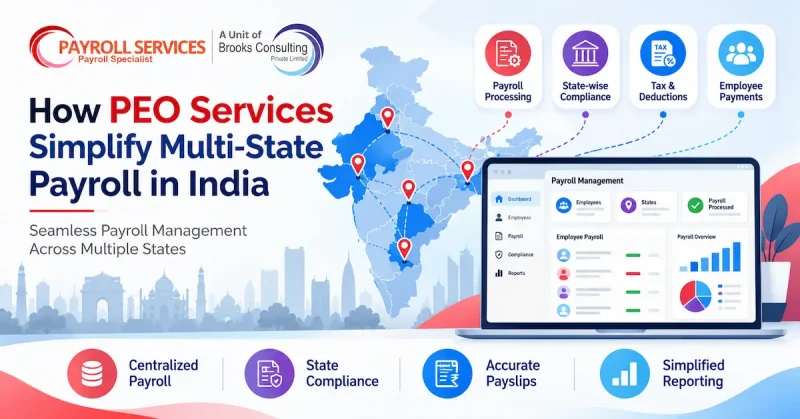
How PEO Services Simplify Multi-State Payroll in India
Managing payroll across multiple states in India is rarely is not always as easy as calculating salaries at the end of every month. Payroll can be a complicated and tedious process because of various state regulations, tax laws, statutory deductions, employee benefits, and compliance requirements.
PEO services in India are a valuable solution for businesses, particularly those expanding into new markets in India, by streamlining payroll across various states, minimizing administrative complexity, and mitigating compliance risks.
A Professional Employer Organization (PEO) can support companies in the processing of payroll, statutory compliance, employee administration, and other HR tasks via a single centralized system. Companies can simplify the management of various payroll needs in various states by relying on a specialised partner.
The result? Simplified administration, better payroll accuracy and more time to grow the business.
What Are PEO Services in India?
A Professional Employer Organization (PEO) is a third party HR and workforce management service provider who provides businesses with HR related administrative tasks.
A PEO may help with the following, depending on the PEO service model:
- Payroll processing
- Employee onboarding and offboarding
- Salary calculations
- Statutory deductions
- Payroll compliance
- Tax-related payroll administration
- Leave and attendance administration
- Employee benefits administration
- HR documentation
- Compliance reporting
- Employee record management
These services can help businesses handle payroll and HR tasks across different states in India in a centralized manner.
Why Is Multi-State Payroll in India Challenging?
The payroll landscape in India is complex and is governed by various Central and State laws and regulations. With employees working in various states, the payroll staff might have to consider variations in employment laws such as professional tax, minimum wage, holidays, registrations, and so on.
1. Different State-Level Requirements
The payroll needs may differ according to the work location. State-specific regulations on professional tax, minimum wages, labor welfare and holidays, among other employment issues, may be relevant to the businesses.
These differences can be difficult to manage manually, and may lead to the risk of errors.
2. Multiple Compliance Deadlines
There are many statutory obligations and deadlines that payroll teams need to adhere to. The more staff, the more locations, the more complications with keeping an up to date compliance calendar
Missing a deadline can result in penalties, additional administrative work, or compliance concerns.
3. Complex Salary Calculations
Employee compensation may include multiple components such as:
- Basic salary
- House Rent Allowance (HRA)
- Special allowances
- Bonuses
- Incentives
- Reimbursements
- Deductions
- Statutory contributions
If employees are working in multiple states, it can become more complex to calculate payroll.
4. Keeping Up With Regulatory Changes
The rules and regulations relating to employment and payroll can be subject to change. There must be processes in place to keep an eye on the updates that apply and to identify if these changes impact employees.
This can take up a lot of time for companies that don’t have payroll and compliance experts in-house.
5. Managing Multiple Employee Locations
A start-up or a rapidly expanding company can have its employees from offices in Delhi, Maharashtra, Karnataka, Tamil Nadu, Telangana, Gujarat etc.
If you’re dealing with multiple locations, separate, and disjointed payroll systems can make it difficult for HR teams to manage payroll.
How PEO Services Simplify Multi-State Payroll in India
PEO services can streamline numerous aspects of payroll and HR functions, enabling businesses to handle their employees in different areas in a more organized method.
1. Centralized Payroll Management
Centralization is one of the major benefit of PEO services.
Companies can choose to implement a single payroll process for all states, rather than having to carry out different processes for each state, with the help of a specialized provider.
A centralized approach can help businesses:
- Standardize payroll processes
- Consolidate employee information
- Reduce repetitive administrative work
- Improve payroll visibility
- Simplify reporting
- Create consistent payroll controls
This can be especially beneficial as a business grows to new states.
2. Support With State-Specific Compliance
A PEO can assist businesses to determine and manage requirements from a payroll perspective that are relevant to employees at various locations.
This may include support related to:
- Professional tax
- Provident Fund (PF)
- Employee State Insurance (ESI)
- Tax deductions
- Minimum wage requirements
- Labor-related registrations
- Statutory filings
- Applicable state-level requirements
Rather than having a separate HR staff to manage each of their locations, companies can join a company that focuses on payroll and employment administration.
3. More Accurate Payroll Processing
The mistakes within the payroll system can cause considerable unhappiness for the workers and extra stress for HR departments.
Automated payroll calculations, validation checks, and structured approval processes are some of the areas where PEO-supported payroll processes can introduce standardized workflows.
This can be helpful in minimizing the following common problems:
- Incorrect salary calculations
- Missed deductions
- Incorrect statutory contributions
- Duplicate employee records
- Incorrect leave adjustments
- Payroll processing delays
4. Easier Employee Onboarding
Expanding into a new state can be an urgent process of quickly bringing on staff.
PEO services can assist in the onboarding process, which includes managing documentation, employee records, setting up payroll, and any compliance needs that apply.
This enables organizations to develop an onboarding procedure that is consistent and repeatable, and not have to build a new process for each location.
5. Simplified Payroll Reporting
Large amounts of information may be generated through multi-state payroll.
A PEO can provide you with valuable payroll information in a report that brings together the following information:
- Employee compensation
- Payroll costs
- Statutory deductions
- Employer contributions
- Leave information
- Employee headcount
- State-wise payroll expenses
Centralized reporting provides management and HR with a more comprehensive picture of how much his or her workforce costs by site.
6. Reduced Administrative Burden
Payroll processing is an ongoing task.
Otherwise, internal HR may have to spend a lot of time in calculating salaries, compliance dates, taking care of employee queries related to payroll, reports of salary, etc.
Outsourcing selected payroll and HR functions to a PEO can allow internal teams to dedicate more time to:
- Recruitment
- Employee engagement
- Performance management
- Workforce planning
- Business expansion
- HR strategy
PEO vs. Traditional Payroll Outsourcing
PEO services do not necessarily mean traditional payroll outsourcing.
Payroll outsourcing has typically been about handling payroll and other administrative tasks.
A PEO can https://www.payrollservicesindia.comoffer a wider choice of HR and employment administration services.
| Feature | Traditional Payroll Outsourcing | PEO Services |
| Salary processing | Yes | Yes |
| Payroll administration | Yes | Yes |
| Statutory compliance support | Often | Yes |
| Employee onboarding support | Limited/varies | Often |
| HR administration | Limited | Broader |
| Employee lifecycle support | Limited | Often |
| Multi-state payroll support | Depends on provider | Common use case |
| HR documentation | Varies | Often |
| Workforce administration | Limited | Broader |
The choice of model will vary based on the company’s size, staffing, geographical distribution, internal HR practices, and/or compliance needs.
Key Benefits of PEO Services for Growing Businesses
Cost Efficiency
Having an in-house team for payroll and compliance can result in the need for extra staff, software, training and operational costs.
The PEO model can provide businesses with access to specialized payroll and HR services without having to develop them in-house.
Better Compliance Management
Compliance is an ongoing process with payroll. A specialist can assist in setting up procedures for monitoring relevant requirements and conducting everyday tasks connected to payroll.
Faster Expansion
Payroll and HR management ought not to be a hurdle to hiring when a company decides to expand to a new state.
A PEO may offer a proven system to assist workers across various sites, making workforce growth more manageable.
Improved Employee Experience
Staff members assume that wages are correct and that they will be paid on time
They should also have easy access to payroll data and information, deductions, leave balances, and employment data.
Payroll automation can help to create a more uniform employee experience.
Scalability
As a company expands its workforce, its unique payroll needs evolve.
An integrated PEO solution can help keep these growing workforces and more sites under control without having to redesign payroll processes on an always-frequent basis.
Who Can Benefit From PEO Services in India?
PEO services can be especially beneficial in the following situations:
- Startups hiring employees across multiple states
- Foreign Companies to be introduced in Indian market.
- SMEs that are growing their staff numbers.
- Companies opening offices in new cities
- Companies that lack an employee payroll specialist on staff.
- Companies wanting to simplify HR management
- Companies with distributed or remote teams.
- Companies that want to have centralized payroll.
Consistency in managing payroll from various locations can be a significant operational benefit for organizations experiencing rapid growth.
How to Choose the Right PEO Service Provider in India
Choosing a PEO provider is more than just a price comparison.
When businesses consider a partner, there are a number of factors that should be taken into consideration.
1. Multi-State Expertise
Inquire if they have experience in helping employees in the various states where your business does business.
2. Compliance Capabilities
Know regulatory change management and how the provider keeps to statutory protocols and processes for payroll.
3. Payroll Technology
Research dependable systems that can be automated, employee self-service, payroll reporting, secure data storage, and integration with current HR systems as needed.
4. Data Security
Employee data is sensitive and is an integral part of payroll. Assess the security, privacy policies, access controls and data protection practices of the provider.
5. Customer Support
Payroll problems might be time-sensitive. Make sure that the provider is available to assist HR staff and employees in a timely manner.
6. Transparent Pricing
Know what you can expect from the service. Be sure to inquire about implementation fees, fees per employee, compliance services, other HR services, and so on.
PEO Services and Business Expansion Across India
Suppose a company starts with 20 employees in one state and eventually grows to 150 employees in 5 states.
If there isn’t a standard payroll system, the HR team might have to handle various state compliance requirements, records, payroll calculations, compliance schedules, and reporting procedures.
In the PEO-supported model, many of these responsibilities can be coordinated via a central model.
This does not mean the company no longer has responsibility for making suitable employment decisions, but it may ease the company’s administrative processes relating to its employees.
Common Mistakes Businesses Make With Multi-State Payroll
Businesses often encounter payroll challenges when they:
- Assume that all states are the same in their requirements
- Have a significant amount of manual spreadsheets to manage processes
- Not keeping employee records up to date.
- Simply ignore the state payroll requirements
- Failure to file the required documents on time.
- Delay payroll reconciliation
- Utilize separated HR/ Payroll systems.
- Lack a clear compliance calendar
- Do not set up payroll processes until expansion is in progress.
An effective proactive payroll approach can help companies prevent the unnecessary administrative complexity.
How PEO Services Improve Payroll Efficiency
A well-designed PEO model can provide a scalable payroll process:
Employee Data → Payroll Calculation → Compliance Checks → Statutory Deductions → Approval → Salary Processing → Reporting
Designed in a systematic way, this will help to establish uniformity among various workstations.
There are additional repetitive tasks that can be automated, and HR teams can gain increased visibility of payroll operations as well.
Conclusion
Nevertheless, managing payroll in various states in India would not be a headache for organizations. Using the important PEO solutions in India, companies can consolidate their executive functions, minimize repetitive aspects of human resource management, and make their payroll processing system compliant with Indian law.
Indeed, our task in helping businesses with their payroll system in India is not just to being able to process it but also to work on creating an efficient and reliable project that will ensure continuous growth regarding payroll processing.
Ready to Simplify Multi-State Payroll in India?
FAQs | PEO Services in India
1. What is a PEO in India?
A Professional Employer Organization (PEO) is a third-party company providing its clients with payroll and employment services, including those related to compliance.
2. Can a PEO manage payroll across multiple Indian states?
Yes. One of the areas where PEO services can be helpful is multi-state payroll management. Providers can assist with payroll processing and any applicable state-level compliance at multiple sites.
3. Are PEO services suitable for startups?
Yes. PEO services are a good option for startups to get payroll and HR management set up without having to establish a large HR and payroll team from the ground up.
4. Does a PEO reduce payroll compliance risk?
While a PEO can be a valuable resource in standardizing payroll and compliance practices, businesses must also be aware of their legal obligations and choose a PEO provider with relevant experience.
5. Can PEO services help foreign companies hiring in India?
PEO or related employer-of-record/workforce-management solutions might be helpful for overseas companies bringing on or growing their workforce in India. This will depend on the structure and employment needs of the company.