
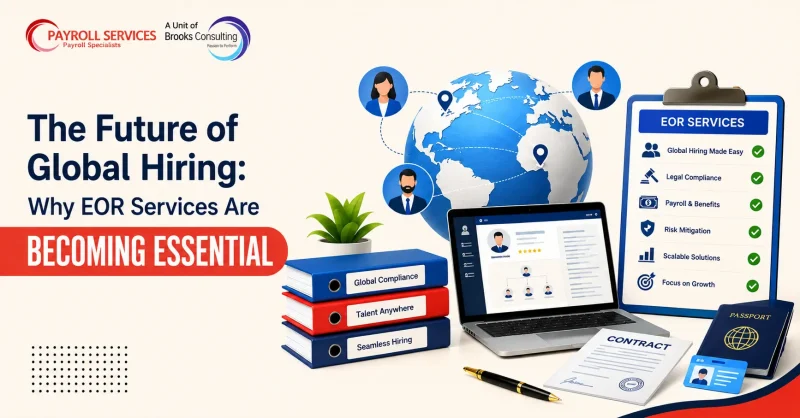
The Future of Global Hiring: Why EOR Services Are Becoming Essential
The Future of Global Hiring Starts Beyond Borders
The ideal employee might not be in the same country as the company hiring them.
Businesses today can find exceptional developers in India, designers in Europe, salespeople in Latin America, and executives in almost any other talent market.
Global hiring has never been easier, with remote work and digital collaboration, and the more dispersed nature of today’s organizations.
But there is a problem.
It is much easier to find global talent than to hire a global talent.
Each new country may have its own employment regulations, payroll procedures, tax regulations, statutory benefits, termination processes, contracts and compliance requirements. It can be costly and time consuming to establish a legal entity in each market and can leave companies vulnerable to classification and compliance issues with informal contractor arrangements.
That’s where EOR services are playing a pivotal role in today’s global hiring landscape.
An employer of record (EOR) serves as the official employer of a worker in a nation where the hiring company does not have a legal entity. The employer of record is in charge of tasks such as employment contracts, tax obligations, payroll, benefits, and local employment compliance in the country, but the client company manages the worker’s job duties on a daily basis.
In other words, EOR services help Businesses Bridge the gap between global talents
Acquisition and conforming international work.
But as companies look across the globe for specialized talent, the bridge is becoming more and more critical.
What Are EOR Services?
EOR services, also known as Employer of Record services, are a way for a company to hire employees in another country without forming a legal entity in that location.
The EOR legally assumes the employment law and payroll responsibilities and the client company usually maintains the day-to-day control, responsibility, projects, performance, and role of the employee.
A typical EOR service can include:
- International employee onboarding
- Employment contracts that are in line with local regulations
- Payroll processing
- Tax withholding and reporting
- Statutory benefits administration
- Employment compliance
- Leave and absence administration
- Employee documentation
- Offboarding and termination support
- Local HR guidance
- Multi-country workforce administration
This provides companies with an opportunity to recruit foreign employees without the additional administrative hassle of establishing and maintaining a foreign company right away.
How Does an Employer of Record Work?
The EOR model is a relatively simple one.
Step 1: Find the right candidate
Company finds and hires a candidate in another country via their regular recruitment process.
Step 2: The EOR becomes the legal employer
The EOR doesn’t hire the individual, but rather through its local entity or employment infrastructure, and prepares the necessary employment documents.
Step 3: The employee joins the company
The employee operates as part of the client’s team, and follows the client’s operational direction, culture, goals and workflows.
Step 4: The EOR manages employment administration
The EOR will manage things like payroll, statutory payments, employment records, benefits administration, and local compliance.
Step 5: The Company focuses on growth
The business will save time and manpower in creating its international HR and legal structure, rather than starting from scratch.
One of the key reasons for the increased popularity of EOR services among globally dispersed businesses is this division of operational management and legal employment administration.
Why EOR Services Are Becoming Essential for Global Hiring
Global workforce is evolving at a fast pace. No longer do companies need to hire in the area of their headquarters.
International rules on employment continue to be very local.
This is a significant challenge:
But the world of work and employment law has a strong sense of place. While businesses desire a borderless talent strategy, employment law is very much country-specific.
EOR services can solve this problem.
1. Access to Global Talent Without Geographic Limitations
When organizations lack the talent needed to support their business, it can dramatically slow the growth of the company’s business.
A business that only hires employees from one nation could be unable to obtain the blend of technical skills, experience, language proficiency and industry knowledge.
The global hiring process opens up a vast talent pool.
Through using the EOR model, businesses can explore global markets while avoiding the need to set up a subsidiary in each country they wish to hire in.
This allows for talent to be more easily dispersed in groups instead of location.
2. Faster International Hiring
Expanding internationally according to traditional means may include creating a legal business entity, tax obligations, formalities regarding incurring payroll costs and developing financial structures, various sorts of registration, and another administrative phase.
An EOR can streamline this by offering an existing employment system.
That means businesses can shift from:
We have the ideal person, but we can’t legally hire them just yet.”
To:
“We have a compliant employment pathway ready for this candidate.”
The timeframe can differ depending on the country and the provider, but the general benefit to the person is that they will be done faster and with fewer administrative hassles.
3. Simplifying Global Employment Compliance
Compliance is one of the most difficult hurdles for international hires.
Job laws vary significantly from country to country – and even from jurisdiction to jurisdiction.
Businesses may need to understand:
- Minimum employment standards
- Working-hour regulations
- Paid leave requirements
- Notice periods
- Termination procedures
- Mandatory benefits
- Social contributions
- Payroll taxes
- Employment contracts
- Data protection requirements
- Employee classification
- Local HR obligations
There may be financial, legal, and reputational repercussions if there is a mistake.
EOR providers have expertise in employment administration in the country and can offer specific procedures and experience.
At the same time, companies should keep in mind that an EOR is not meant to replace informed decision-making. They should carefully assess whether the provider has sound legal provision, ability to cover more than one country, compliance with local laws, and contractual security.
4. Reducing the Complexity of International Payroll
In a multi-country payroll environment, payroll becomes significantly more complex.
Different markets may have different:
- Payroll cycles
- Tax systems
- Currency requirements
- Social security contributions
- Statutory deductions
- Benefits
- Payslip requirements
- Reporting obligations
This internally managed workflow can be a good use of HR, finance, payroll and legal resources.
EOR services streamline many of these complexities by taking care of payroll processing based on local regulations, and offering the client company an overview of its global employees.
This can make global payroll much simpler to handle for businesses that have offices in more than one country.
5. Supporting Remote and Distributed Teams
The concept of remote working has revolutionised business thinking around employment.
A company may have:
- A headquarters in the United States
- Engineers in India
- Designers in Germany
- Marketing employees in the United Kingdom
- Customer support teams in the Philippines
- Sales representatives in Brazil
This working model can result in massive competitive benefits, but with operational complexity!
EOR services offer an employment solution for companies looking to form distributed teams without creating their own legal structure in each office.
EOR platforms are now part of the global infrastructure for workforce management as remote-first and hybrid organizations keep progressing.
6. Making Global Expansion More Flexible
Not all international markets have a place in a permanent investment portfolio.
A company might wish to go into a different nation to:
- Test market demand
- Hire one specialist
- Build an initial sales team
- Establish a regional presence
- Support a new client
- Recruit hard-to-find technical talent
- Evaluate long-term expansion opportunities
It may be a mistake to immediately establish a subsidiary company when the opportunity is relatively small.
An EOR can offer a more flexible solution as you experiment with international hiring practices without large-scale commitments.
The company can then consider making a strategic and financial sense of its own entity in case the market expands significantly.
EOR vs. Setting Up a Local Entity
A key factor to consider for businesses weighing hiring overseas is whether or not they should consider an EOR or form their own business entity.
| Factor | EOR Services | Local Entity |
| Initial setup | Generally faster | Usually more involved |
| Legal entity required | No client-owned entity required | Yes |
| Payroll administration | Managed by EOR | Managed internally or outsourced |
| Local compliance | Supported by EOR | Company responsibility |
| Initial investment | Generally lower | Generally higher |
| Control over employment infrastructure | Lower | Higher |
| Best for | Early-stage or limited hiring | Established long-term operations |
| International expansion speed | High | Typically slower |
| Administrative burden | Reduced | Higher |
There is no universal winner.
An EOR might be a good option for companies that have a limited number of staff they want to recruit on a short-term basis in a new country. This could be more appropriate if the entity has a large, long-term employee base and a large business presence in that market.
The right decision depends on headcount, hiring plans, country-specific regulations, cost, risk, and long-term strategy.
EOR vs. PEO: What’s the Difference?
EOR and PEO are often confused, but they are not identical models.
A Professional Employer Organization (PEO) normally works in a co-employment configuration and is regularly used in cases the client corporation has already a legal presence.
An Employer of Record, on the other hand, would assume the legal employer for the employment relationship involved and can help businesses to hire in countries in which they are not incorporated.
Businesses should check on the precise working of a provider in each country of operation, as the terminology and legal structure may differ.
“EOR” or “PEO.”
EOR vs. Independent Contractors
It might seem easier to hire international contractors at first.
But this is not the only factor in figuring out if someone is an employee or independent contractor.
Classification may be influenced by the individual’s working relationship, degree of control, responsibilities, economic dependency and local law.
Incorrect classification can result in:
- Back taxes
- Employment claims
- Penalties
- Benefits liabilities
- Social contribution exposure
- Reputational damage
When businesses have to hire a workforce as employees and not through potentially inappropriate contractor agreements, an EOR can be a solution.
This can be a crucial factor in developing an international recruitment plan, as employee classification and compliance need to be taken into account.
The Biggest Benefits of EOR Services
The advantages of EOR services are not just limited to payroll for companies looking for international growth.
Faster market entry
Companies can start recruiting in new markets without having to establish an entity.
Reduced administrative burden
Many aspects of employment in the country can be outsourced to an expert provider, such as HR and finance.
Greater compliance support
Organizations can use local expertise to better understand and manage employment requirements.
Access to international talent
Hiring can be done from anywhere and not just based on location.
Simplified payroll
Multi-country payroll is more easily centralized and controlled.
Flexible workforce expansion
Companies can explore with new markets without having to invest in permanent infrastructure in the area.
Better employee onboarding
Individual contracts, benefits, payroll and employment procedures can help make it easier for international hires.
Improved scalability
EOR platforms can accommodate businesses as they grow from a single international employee to a dispersed workforce in various nations.
How EOR Services Can Improve Employee Experience
Hiring globally isn’t just a problem for the employer.
They also want to have a professional and local work experience.
International employees want to understand:
- How they will be paid
- What benefits they receive
- How much leave they have
- What their employment rights are
- How taxes are handled
- Who supports them with HR questions
- What happens during onboarding
- How compensation is administered
The right EOR provider can help to develop local hiring procedures and ensure a seamless company experience.
This is important because good employee experience can impact retention, employee engagement, and the organization’s international talent acquisition capability.
The Role of Technology in Modern EOR Services
The EOR industry is becoming more technologically driven.
Modern platforms can integrate several workforce processes into one location such as:
- Employee onboarding
- Contract management
- Payroll
- Benefits
- HR documentation
- Compliance workflows
- Employee lifecycle management
- Global workforce reporting
Some providers also have combinations with HR and finance systems to help minimize manual administration.
This translates into a change in the way the industry is managed from outsourced administration to an employment infrastructure that is enabled by technology, and is global in scope.
The Future of EOR Services
Global hiring will be more distributed, more dat driven, and more international in the future.
The next generation of EOR services is influenced by several trends.
AI-Powered Compliance
AI and automation can aid EOR platforms in tracking regulatory updates, pinpointing potential compliance risks, streamlining processes, and delivering quicker access to employment details.
But human legal and HR skills will still be needed as employment laws are very contextual and may vary from one jurisdiction to another.
Global Payroll Automation
Payroll systems are expected to support multiple countries, currencies, tax issues, and employment structures, and this is increasingly being done in a centralized fashion.
Automating repetitive administrative tasks can help increase visibility.
Integrated Global HR Platforms
Payroll, HR, compliance, benefits and workforce management are increasingly converging with global mobility.
In the future such functions may be combined more into future EOR platforms.
Better Global Benefits
International staff are not looking for just legal minimums in terms of compensation.
As a result, EOR providers are becoming more crucial in assisting companies to create customized and competitive employment offers.
Greater Focus on Data Security
Global employment requires employee sensitive information.
Businesses will be sending teams overseas and providers will have to have good security, privacy, access control and data management procedures.
Strategic Workforce Expansion
EOR services are moving beyond being simply an administrative solution.
They can form the backbone of a larger employment plan which can help companies decide on:
Where should we hire?
When should we hire?
Should we establish an entity?
Which markets have the right talent?
How quickly can we expand?
This makes EOR more and more relevant to HR, finance, legal, operations and executive leadership.
What Businesses Should Look for in an EOR Provider?
The selection of the right EOR Company is crucial.
Not all providers have the same infrastructure, country coverage, technology, compliance capabilities, or service model.
Before selecting an EOR, evaluate:
1. Country coverage
Are you able to hire from the countries that the provider supports, and the countries you want to hire in next?
2. Local legal infrastructure
Identify the type of structure used by the provider (direct, in partnership, or other) in each country.
3. Compliance expertise
Question the provider about how he or she keeps track of changes in regulation and how he or she processes employment-law updates.
4. Payroll capabilities
Review currency support, payroll accuracy, payment schedule, tax administration and reporting.
5. Benefits
Look for competitive and local benefits from the provider.
6. Technology
Find a user-friendly platform with transparency options for employee data, payroll, documents, and workforce expenses.
7. Customer support
Issues around international employment can be time-sensitive. Check if you have special support and access to local experts.
8. Pricing transparency
Have a full understanding of the cost of the setup, including monthly EOR fees, currency fees, benefits, and extra services.
9. Data protection
EORs have access to important employee data, so check their security measures and privacy policies.
10. Intellectual property protection
In the case of technology firms, check the systems for dealing with intellectual property and invention rights in each jurisdiction.
When Should a Company Use EOR Services?
EOR services can be particularly useful when:
- You want to hire your first international employee.
- You need specialized talent unavailable locally.
- You are testing a new international market.
- You operate a remote-first company.
- You need to expand internationally quickly.
- You don’t want to establish multiple foreign subsidiaries.
- Your HR team lacks international employment expertise.
- You need centralized global payroll administration.
- You are transitioning from contractors to employees.
- You are scaling a distributed workforce.
However, EOR is not automatically the best option for every organization.
Large, long-term workforces in a specific country could eventually determine that setting up a local presence is likely to enable greater control or better long-term economics.
The aim should not be to continually use an EOR.
The objective is to select the employment infrastructure that is suitable for your business on every growth phase of it.
Common Mistakes Companies Make When Using EOR Services
Companies still require robust internal processes, even if they have an EOR.
Avoid these common mistakes:
Choosing based only on price
The lowest price does not necessarily represent the best compliance infrastructure, staff support, and technology or country coverage.
Assuming every country works the same way
The rules governing employment are different in different jurisdictions.
Treating an EOR as a recruitment agency
The responsibility of the EOR is normally to administer employment, not necessarily talent sourcing.
Ignoring employee experience
Even a well-structured job offer can lead to frustration in a bad onboarding, with inadequate payroll and benefits and poor communication.
Failing to plan for scale
Best provider for 2 employees in one country might not be best provider for 100 employees in 15 countries.
Not reviewing contracts carefully
Before signing, companies should be aware of the responsibilities and liabilities, as well as how they are terminated, what IP considerations they will need to take into account, how the data will be handled, and the pricing.
The Strategic Impact of EOR on Global Businesses
The primary difference between hiring services for the enterprise and EOR services for global hiring is far from just administrative.
It is strategic flexibility.
Traditionally companies would go overseas in the following order:
Select the market, set up the business, develop the infrastructure and employ staff.
EOR services can change the sequence:
Find talent & hire appropriately → experiment the market, scale if necessary or appropriate, and create an entity if necessary.
This gap can provide some freedoms for developing businesses.
Rather than investing in a big infrastructure first, and then seeing if the market will grow, companies can try to test the market first and then invest in infrastructure.
This can be especially useful for startups, scale-up, technology and professional services firms, as well as wherever your team is distributed.
Is EOR the Future of Global Hiring?
EOR services are not expected to be a replacement to all types of international employment.
In large multinational companies, with significant activities, they can still have their own entities.
For firms undertaking long-term investments in particular markets, local subsidiaries will continue to be relevant.
Independent contractors will stay suitable in correct contractor relationships.
However, for companies seeking to hire internationally without having to create an in-house workforce or infrastructure, EOR services prove to be an attractive option.
The overall picture is emerging: employers are more interested in tapping into global talent pools than in running noncompliant and inefficient employment practices.
EOR providers sit directly at that intersection.
Conclusion: Global Talent Is the Opportunity. EOR Is the Infrastructure.
The future of work doesn’t always have to mean a company’s office.
It is increasingly defined by where the right talent is located.
However, recruitment isn’t enough to be successful in global hiring. Having consistent systems for employment, payroll, compliance, benefits, onboarding and workforce management are essential for businesses.
That’s why EOR services are increasingly becoming essential for worldwide hiring and international expansion.
The winners of the international battle of the talent pool won’t just be the ones who can recruit from anywhere in the world.
They will be the companies that can hire, onboard, pay, support and retain that talent compliantly—no matter where they are located.
Ready to Build Your Global Workforce?
FAQs
1. What are EOR services?
EOR service enables companies to recruit staff in a foreign nation without having to set up their own local legal entity. An external service provider is tasked with making sure that all paperwork is handled properly along with payroll, taxes, benefits, atlaw compliance and other employment obligations.
2. How does an Employer of Record work?
EOR becomes the official employer of the person who works in the particular country while the client takes care of the way the employee is performing.
3. Why are EOR services important for global hiring?
EOR services can move the business to the international workforce, and simplify hiring, payroll, tax, benefits and compliance in the country.
4. What are the benefits of using EOR services?
The advantages are quicker international staffing, simplified international payroll, payroll compliance support, access to global talent, decreased administrative burden, and increased flexibility on expansion to new markets.
5. What is the difference between an EOR and a PEO?
Usually the EOR becomes the legal employer of the worker and the PEO usually works under a co-employment model in which the client already has a legal entity. This structure may differ from jurisdiction to jurisdiction.
6. Is an EOR better than hiring international contractors?
Not always. Contractors can be appropriate for genuine independent contractor relationships. An EOR can, however, offer a more suitable employment framework and alleviate local employment needs where workers should legally be engaged as employees.
7. When should a company use an EOR?
An EOR can be beneficial if a company plans to hire its first international employee, expand into a new market, utilize a specialized pool of overseas talent, create a remote team or expand overseas while not creating a local entity right away.
8. How does an EOR simplify international payroll?
An EOR can streamline the country-specific payroll processing, tax withholding, statutory contributions, benefits, deductions and payroll documentation for the client company.
9. Can an EOR help with international employment compliance?
Yes. Many employment administration duties are usually handled by EOR providers, such as contracts, payroll, statutory benefits, leave, and more. However, detailed due diligence should still be done on the provider by the companies.
10. How do I choose the right EOR provider?
Pay attention to the countries where they operate, local legal systems, compliance knowledge, payroll functionality, benefits offered, technology, customer support, pricing clarity, data security and IP rights.