
What Documents Do I Need to Hire Through an EOR in India?
Hiring employees in India through an Employer of Record (EOR) is easier than establishing a local entity. However, the EOR must collect certain documents from the foreign company and the employee to complete onboarding, payroll, tax and statutory registrations.
The exact requirements can vary by provider, job role and employee location, but the following documents are commonly required.
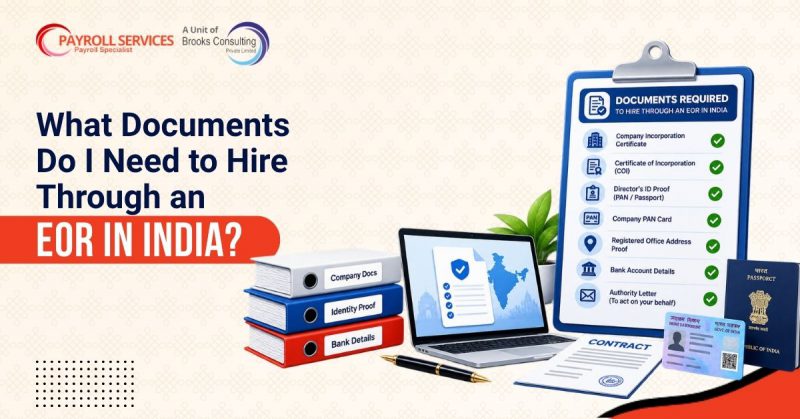
Documents Required from the Hiring Company
The foreign company generally needs to provide:
- Certificate of incorporation or business registration
- Registered business address
- Tax identification number
- Company ownership details
- Details of authorised representatives
- Passport or government-issued ID of the authorised signatory
- Signed EOR service agreement
- Employee’s designation, responsibilities and reporting structure
- Proposed salary and benefits package
- Employment start date
- Intellectual property and confidentiality requirements
- Workplace, remote-work and leave policies, if applicable
The EOR may also request additional information to complete Know Your Business and anti-money-laundering checks.
Documents Required from the Employee
1. Proof of Identity
The employee may need to submit one or more government-issued identification documents, such as:
- Aadhaar card
- PAN card
- Passport
- Voter ID card
- Driving licence
A PAN card is particularly important for payroll processing and income-tax reporting.
2. Proof of Address
Commonly accepted address documents include:
- Aadhaar card
- Passport
- Voter ID card
- Driving licence
- Recent utility bill
- Registered rental agreement
- Bank statement
The employee’s current and permanent addresses may both be required.
3. Bank Account Details
For monthly salary payments, the employee usually needs to provide:
- Cancelled cheque
- Bank passbook copy or recent bank statement
- Account holder’s name
- Bank account number
- IFSC code
- Bank and branch name
The account should normally be registered in the employee’s name.
4. Employment and Educational Records
Depending on the position and the company’s verification policy, the EOR may request:
- Updated CV or résumé
- Academic certificates
- Professional qualifications
- Previous employment offer letters
- Experience or relieving letters
- Recent salary slips
- Previous employer references
These documents may also be used for background verification.
5. Provident Fund Information
If the employee was previously registered with the Employees’ Provident Fund Organisation, they may need to provide:
- Universal Account Number
- Previous provident fund details
- PF passbook or previous payslip
- Completed statutory declaration or transfer form, where applicable
The existing UAN should usually be retained instead of creating a duplicate account.
6. Tax Documents
Documents required for payroll tax calculations may include:
- PAN card
- Previous employer’s Form 16
- Current financial year salary details
- Tax declaration
- Investment and deduction proofs
- Previous employment income statement
- Details of other taxable income, where declared
These documents help the EOR calculate tax deducted at source accurately.
7. Other Statutory Information
Depending on eligibility and local requirements, the employee may also be asked for:
- Employees’ State Insurance details
- Nominee information
- Emergency contact details
- Date of birth
- Marital status
- Dependent details
- Gratuity nomination
- Passport-size photograph
Additional Documents for Foreign Employees
If a non-Indian citizen will work in India, additional documents are generally required, including:
- Valid passport
- Appropriate employment visa
- Visa application and approval documents
- Residential permit or registration
- Local address proof
- Tax registration details
- Employment contract
- Educational and professional certificates
Immigration requirements should be reviewed before the employee starts working in India.
Documents Prepared by the EOR
After receiving the required information, the EOR generally prepares:
- Compliant employment agreement
- Offer or appointment letter
- Salary structure and cost-to-company statement
- Confidentiality agreement
- Intellectual property assignment
- Employee handbook acknowledgement
- Data-protection consent
- Benefits enrolment forms
- Statutory declarations and nomination forms
- Remote-working or equipment agreement, if required
Because the EOR is the employee’s legal employer, these documents are generally issued in the EOR’s name while reflecting the agreed role and working relationship with the client company.
How Long Does Document Verification Take?
Document collection and verification commonly take a few business days when all information is complete. Delays may occur because of:
- Incorrect bank information
- Missing PAN or Aadhaar details
- Name differences across documents
- Duplicate UAN records
- Incomplete employment history
- Background-verification issues
- Visa or immigration requirements
Companies can accelerate onboarding by collecting the employee’s basic information before submitting the hiring request to the EOR.
EOR Hiring Document Checklist
Before onboarding begins, make sure the following items are available:
- Company registration documents
- Authorised signatory details
- Final job description
- Salary and benefits information
- Employee identity and address proof
- PAN and bank details
- Educational and employment records
- PF, ESI and tax information
- Signed employment documents
- Visa and immigration records, if applicable
Conclusion
To hire through an EOR in India, businesses normally need to provide their company registration information, authorised signatory details, job description and proposed compensation package. Employees generally need identity, address, banking, tax, educational and previous employment documents.
A reliable EOR reviews these records, prepares a compliant employment contract and manages payroll, tax deductions, statutory registrations and ongoing employment administration.
Brooks Consulting helps international businesses hire employees in India without establishing a local entity. Our EOR specialists manage documentation, onboarding, payroll and compliance, giving you a faster and more reliable way to build your Indian team.