
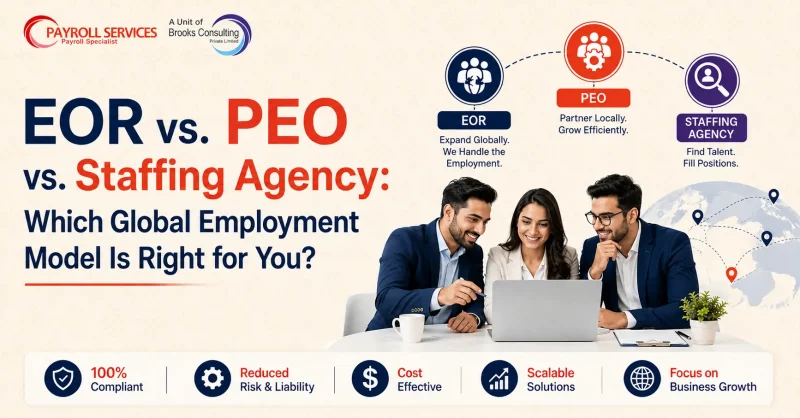
EOR vs. PEO vs. Staffing Agency: Which Global Employment Model Is Right for You?
The process of hiring internationally has never been easier; however, the employment model is not as simple as it may seem.
If a company is considering hiring any employees, contractors, temporary workers or international employees, three terms are likely to be mentioned: EOR, PEO, and staffing agency. While each of these models can aid enterprises in constructing and handling a workforce, they address entirely different issues.
Choose the wrong model, you may end up paying unnecessary fees, assuming employment obligations instead of outsourcing them, restricting your ability to manage employees and facing compliance issues in a country where you don’t fully understand the employment laws.
Choosing the appropriate model would help in quick hiring of talent as well as ease in managing HR activities along with compliance and market entry.
So, what is the difference between an EOR vs. PEO vs. staffing agency?
The simplest way to think about it is:
- EOR (Employer of Record): Suitable for circumstances where a company wants to recruit employees in a foreign country where that company has no legal operations.
- PEO (Professional Employer Organization): This is ideal when you already have an organization, and you wish to outsource or share HR, payroll, benefits and employment administration in a co-employment agreement.
- Staffing Agency: Use if you need to find staff, especially temporary, contract, project based or contingent employees.
EOR, PEO and staffing agency are not synonymous. They have different legal frameworks, responsibilities, costs, risks and applications.
This guide outlines all the models in depth and provides a practical model to help you decide which solution is right for your business in your employment in the global market.
EOR vs. PEO vs. Staffing Agency: Quick Comparison
Before diving into the details, here’s the high-level difference:
| Factor | EOR | PEO | Staffing Agency |
| Primary purpose | Employ workers on your behalf | Outsource/shared HR administration | Source and provide workers |
| Your company needs a local entity? | Usually no | Generally yes for a traditional PEO | Usually no |
| Who is the legal employer? | EOR provider | Co-employment/shared structure, depending on jurisdiction and contract | Usually staffing agency for assigned workers |
| Best for | International hiring and market entry | HR outsourcing where you already operate | Temporary, contract, or contingent hiring |
| Candidate selection | Your company | Your company | Often shared, with agency sourcing |
| Day-to-day work direction | Your company | Your company | Usually client company |
| Payroll | EOR | PEO | Staffing agency |
| Benefits administration | EOR | PEO | Staffing agency |
| Employment compliance | Primarily managed by EOR, subject to contract and local law | Shared/allocated according to structure | Agency handles its employment obligations; client retains its own responsibilities |
| Local entity required | No, in the typical EOR model | Yes, generally | No, typically |
| Ideal workforce | Permanent international employees | Existing employees | Temporary/contract/contingent workers |
| Market-entry solution | Excellent | Limited | Not primarily designed for this |
| Recruiting focus | Usually not the core function | Not primarily | Core function |
| Long-term international expansion | Excellent | Useful after entity establishment | Useful for contingent workforce |
Important: Employment arrangements and legal duties differ from country to country. A provider’s marketing label does not necessarily reflect their legal role. Always check the actual contract, local entity structure and employment laws.
What Is an EOR?
EOR stands for Employer of Record.
Employer of Record is a third party that assumes the legal status of the Employer for a worker for your company in a jurisdiction where you intend to hire.
Your company usually has control over how the employee conducts their daily job, their duties, their performance, and their business goals, but the EOR is responsible for the official employment contract.
This can include:
- Employment contracts
- Payroll processing
- Tax withholding and reporting
- Statutory benefits
- Employment-related registrations
- Leave administration
- Local employment compliance
- Onboarding and offboarding
- Required employment documentation
- Certain employee benefits
- Termination administration
However, the specific scope will vary according to the country and the EOR agreement.
How Does an EOR Work?
Suppose a Software Company in the USA is looking to hire a software engineer in india
The company has two broad choices:
- Create its own German company and hire the staff.
- Implement an EOR with an established local employment system.
Under an EOR, the EOR assumes responsibility for the legal relationship between the employee and employer, and the software company will typically be responsible for how the employee works.
This enables the business to recruit internationally without having to set up an overseas subsidiary right away.
Why Companies Use EOR Services
An EOR may be useful for a company that desires to:
- Enter a new country quickly
- Employ one or a couple of foreign employess.
- Test a new market
- Attract highly qualified international staff
- Support remote employees
- Avoid establishing a foreign entity immediately
- Centralize international payroll
- Minimize local workforce regulatory compliance burden
An EOR can thus serve as a market entry and global employment infrastructure solution for companies looking to expand into the international market.
What Is a PEO?
PEO stands for Professional Employer Organization.
A PEO is a firm that outsources HR services and employment and recruits the staff in a co-employment agreement.
Actual legal and tax consequences differ from state to state. Under certain arrangements, the PEO can, in the United States, assume responsibility for functions like payroll administration, benefits administration and employment tax functions. In addition, the IRS has a voluntary certification program for Certified Professional Employer Organizations (CPEOs) with unique federal employment-tax implications.
A traditional PEO is not exactly like an EOR since the client firm already has its own legal entity and most likely employs the employees.
The PEO does the rest by assuming or delegating some of the HR and administrative tasks.
What Does a PEO Do?
PEO services may consist of:
- Payroll processing
- Benefits administration
- HR administration
- Workers’ compensation administration
- Employee onboarding
- HR compliance support
- Employment tax administration
- Employee handbook support
- Risk management
- HR technology
- Certain employee relations support
In general, the business has a high degree of control over the workforce and its operations.
PEO vs. EOR: The Fundamental Difference
The simplest one is:
A PEO typically helps an employer and its employees, but an EOR can help create the legal structure for employing employees when the employer doesn’t have one.
This is a key difference when it comes to hiring internationally.
For companies that already have a local entity, a PEO might be a good choice.
An EOR is typically the contract type you should consider if you wish to have someone working for you in a country that you don’t have an entity.
What Is a Staffing Agency?
Staffing agency makes it easier for businesses to identify and hire employees.
While a business working with an EOR will probably know exactly what they are looking for, a staffing agency might be actively involved in the recruitment, screening, selection and supply of talent.
Staffing agencies are particularly common for:
- Temporary workers
- Contract workers
- Seasonal employees
- Project-based teams
- Contingent workers
- Temp-to-hire arrangements
- High-volume hiring
- Short-term workforce requirements
If the staffing agency employs the worker, and pursuant to the agreement and law, the worker works at the client organization.
What Does a Staffing Agency Do?
Services can include:
- Candidate sourcing
- Recruiting
- Screening
- Interviews
- Background checks
- Payroll
- Workforce administration
- Temporary placement
- Contractor management
- Assignment management
Often, the staffing agency’s value proposition is not providing you with a solution for an international entity to hire a permanent employee you already know and have chosen, but rather to supply talent and flexibility in the workforce.
EOR vs. PEO vs. Staffing Agency: The Biggest Difference
The simplest method to comprehend these models is to establish the problem you intend to solve.
If your problem is:
I have located the person I want to hire, but I don’t have an entity in their country.
→ Consider an EOR.
If your problem is:
An entity and employees are already in place, but managing payroll, benefits, HR and compliance is taking too much of our internal time.
→ Consider a PEO.
If your problem is:
Qualified employees are needed in a hurry, for a temporary or project-based or contingent workers.
→ Consider a staffing agency.
This is a problem-first approach, which is often more helpful than looking at providers and their marketing jargon.
EOR vs. PEO: What’s the Difference?
One of the most misunderstood, but significant components of global workforce management is the difference between an EOR and a PEO.
1. Legal Employment Structure
In general, under an EOR, the provider will be the legal employer of the worker in the jurisdiction of the arrangement.
With a traditional PEO, the client generally already has an employing entity and enters into a co-employment relationship with the PEO.
Specific responsibility allocation will vary according to local legislation and agreement.
2. Need for a Local Entity
This is typically the most significant practical difference.
EOR
Depending on the legal structure and local regulations of the EOR, a company may be able to hire internationally before forming its own legal entity in the country.
PEO
The traditional PEO is typically used with an existing company with employees in the relevant jurisdiction.
Therefore:
The more common model is No entity + international hire = EOR.
Existing entity + HR outsourcing = PEO may be the better fit.
3. Compliance Responsibilities
An EOR generally takes on a considerable amount of responsibility to cover the formal employment relationship, which contains employment administration and local payroll.
A PEO shares in or helps with the responsibilities of employment, but the client is usually a significant component of the legal job relationship.
Such a separation is particularly significant as outsourcing HR administration does not necessarily waive the client’s legal responsibilities.
EOR vs. Staffing Agency: What’s the Difference?
There are some differences in the way that an EOR and a staffing agency operate, as both may have a third party working their employees.
EOR
The company usually comes up with the candidate that they want to employ.
The EOR offers legal employment support.
The company generally manages:
- Job responsibilities
- Day-to-day work
- Performance
- Team structure
- Business objectives
The formal employment administration is the responsibility of the EOR.
Staffing Agency
The agency will generally be much more active in the sourcing and supply of workers.
The relationship can be either an on-going relationship or a project relationship.
This is why staffing agencies are particularly useful when the company is in need of:
- Speed
- Flexibility
- Temporary labor
- Contingent workers
- High-volume recruiting
- Specialized staffing support
Example
Assume a company requires 20 seasonal employees for three months.
A staffing agency could be an excellent fit.
Let’s assume that the company has already identified a senior engineer, who has a permanent residence in another country, and would like to hire him for a long term.
Using an EOR may be more suitable.
PEO vs. Staffing Agency: What’s the Difference?
A PEO is basically an HR and employment administration model.
The essence of a staffing agency is a talent sourcing and workforce supply model.
A company that employs PEO staff and just needs assistance in managing the administrative aspects of employment.
A company that is using a staffing agency can require the agency to recruit and supply employees.
PEO is usually about:
“Help us manage the workforce we already have.”
Staffing is usually about:
“Help us find and provide the workforce we need.”
EOR vs. PEO vs. Staffing Agency: Detailed Comparison
Employment Relationship
EOR
The EOR generally serves as the legal employer in the country.
PEO
Under the PEO agreement, the employer and the PEO become co-employers.
Staffing Agency
Typically, a staffing agency will employ and assign employees in a staffing relationship.
Recruiting
EOR
While it is possible to hire via EOR, the core role of an EOR is employment infrastructure.
PEO
Recruiting is allowed, but not a matter of the PEO model.
Staffing Agency
Recruiting and talent sourcing are fundamental services.
Payroll
All three of the models might include payroll administration, but in each case the relationship is different.
An EOR generally handles the payroll for employees that are legally under their care.
As a co-employer, a PEO can handle all of the payroll functions.
A staffing agency usually pays the employees that they hire or assign.
Responsibilities for tax and payroll vary by legal structure and jurisdiction.
Benefits
The EORs are able to provide any statutory and supplemental benefits as per the country’s requirement.
As part of HR offerings, PEOs can offer access to and administration of benefits.
Staffing agencies may provide benefits to eligible temporary or contract workers depending on the agency, assignment, and applicable laws.
Which Model Is Best for International Hiring?
The question that springs to mind for many companies is:
Have an entity already established in the country in which you wish to hire the worker?
If no:
An EOR is often the most relevant option.
If yes:
Depending on your HR infrastructure, a PEO or an employment model could be better suited.
If you need temporary or contingent workers:
A staffing agency might be a better choice.
When Should You Choose an EOR?
An EOR is an excellent choice when your business desires to employ overseas but doesn’t want to establish a foreign entity right away.
Consider an EOR if you:
1. Want to Hire One or a Few Employees Abroad
Creating a subsidiary of one employee can be costly and cumbersome.
It is possible for an EOR to offer a more functional employment framework.
2. Want to Test a New Market
When companies don’t have enough capital to incorporate, they can hire staff and establish a local base with an EOR.
3. Need International Talent Quickly
If the ideal candidate is already placed overseas, it may take months to create an entity, which could result in losing the candidate.
4. Employ a Distributed Workforce
EOR services can be utilized by companies with workforces in various countries to keep up employment management in one place.
5. Want to Reduce Local HR Complexity
Employment laws may vary considerably across countries – and even across regions within countries.
An EOR can manage a large portion of the local employment administration.
When Should You Choose a PEO?
A PEO might be a better solution if you already have a working company and employees.
Consider a PEO if you:
- Already have a local legal entity
- Employ multiple workers
- Need HR outsourcing
- Want professional payroll administration
- Need benefits administration
- Want HR compliance support
- Need assistance in employment-related administration
- Want to reduce internal HR workload
If your business has enough staff for a formal HR outsourcing agreement, then a PEO could be a good choice.
When Should You Choose a Staffing Agency?
When flexibility and sourcing talents are paramount, a staffing agency could be the greatest option.
Think staffing when you need it:
- Temporary employees
- Seasonal workers
- Project-based talent
- Short-term specialists
- Contingent workers
- Rapid workforce expansion
- High-volume hiring
- Temp-to-hire workers
The other advantage of staffing is that it could alleviate the internal recruiting pressure since the agency does a good portion of the sourcing.
EOR vs. PEO vs. Staffing Agency for Startups
Entrepreneurs typically have small HR teams and rush to make appointments.
Scenario 1: Startup hiring internationally
A start-up has 10 staff in the USA and is looking for their first developer in Spain.
Potential fit: EOR
It may not be necessary for the startup to set up a Spanish entity for just one employee.
Scenario 2: Startup with an established entity
A start-up with 50 employees in the USA wants to outsource its payroll, benefits and HR administration.
Potential fit: PEO
The business already has the structure and is in need of HR assistance.
Scenario 3: Startup needs temporary sales representatives
A startup requires 15 short-term salespeople for a six-months campaign.
Potential fit: Staffing agency
The obvious need is for temporary workforce provision.
EOR vs. PEO vs. Staffing Agency for Enterprises
Advanced businesses typically tend to utilize over one model.
For example, a multi-national organisation may:
- Use direct employment in countries where it has subsidiaries
- Use EOR services in countries where it has a small number of employees
- Utilize PEO and HR outsourcing-like arrangements in the appropriate jurisdictions
- Use staffing agencies for temporary workers
- Use recruiting firms for talent acquisition
A company does not have to implement one employment model in all nations.
A hybrid workforce strategy, in fact, can be more efficient.
Can You Use an EOR and Staffing Agency Together?
Yes, but they solve different problems.
A company, for instance, may hire a recruiting or staffing firm to search for employees, and hire a permanent employee through an EOR in a country in which it does not have a business presence.
But it is important to make sure the legal relationship is clearly documented.
Relying on an EOR for all recruiting, contractor, or staffing relationships should be avoided by businesses.
Can You Use a PEO and EOR Together?
Possibly, depending on countries, workforce structure.
For foreign countries in which a PEO or EOR exists, a PEO or direct hiring structure could be used in a company’s home country.
This may result in a multi-national employment approach instead of putting each worker into one approach.
EOR Costs vs. PEO Costs vs. Staffing Agency Costs
One of the most important factors to take into account when choosing an employment model is cost.
Yet it’s not a fair comparison to just consider the headline service fee.
You should evaluate the total cost of employment.
EOR Costs
EOR pricing may include:
- Employee salary
- Employer taxes
- Statutory contributions
- Benefits
- Payroll administration
- EOR service fees
- Currency conversion costs
- Optional services
- Onboarding or termination fees
A few EOR services providers offer a flat fee per employee and some use different pricing models.
PEO Costs
PEO pricing can be structured as:
- A percentage of payroll
- Per-employee fees
- Benefits-related charges
- Administrative fees
- Additional HR service fees
The exact monetary expense is dependent on the provider and arrangement.
Staffing Agency Costs
Staffing agencies will often include a margin in the worker’s bill rate.
You may therefore pay:
Worker compensation + employer costs + agency margin/service fee
The overall cost may be more expensive than hiring staff, but the savings in recruiting time, flexibility of staff and admin time may justify the extra expense.
Don’t Compare Only the Service Fee
Assume that the EOR that has a low monthly rate, but high currency conversion costs, limited benefits, high termination fees, and bad local support is called Provider A.
Provider B offers predictable termination procedures, excellent benefits administration, good local compliance support, and accurate payroll with an added month-long price premium.
From an overall cost of employment perspective, Provider B might end up being more cost effective.
When considering EOR, PEO or staffing provider comparisons, consider:
- Service fees
- Employer taxes
- Benefits
- Payroll costs
- Currency exchange
- Onboarding fees
- Offboarding fees
- Termination costs
- Minimum contract periods
- Deposits
- Insurance
- Compliance support
- Local legal support
- Customer service
- Technology
- Reporting
- Contract flexibility
Global Employment Compliance: Why the Model Matters
Carefully differentiating between EOR, PEO and staffing services is one of the best arguments for employment compliance.
International employment may have needs for requirements covering:
- Employment contracts
- Minimum wage
- Working hours
- Overtime
- Paid leave
- Public holidays
- Social insurance
- Payroll taxes
- Income tax withholding
- Employee benefits
- Termination procedures
- Severance
- Notice periods
- Data protection
- Workplace safety
- Worker classification
- Immigration and work authorization
The student needs to be able to work in the United States as well as legally reside in the country.
While an outsourcing agreement does not remove all of a client company’s responsibilities, it could potentially result in the elimination of some of these responsibilities.
How to Choose the Right Global Employment Model
Use this five-step decision framework.
Step 1: Identify Your Workforce Type
Ask whether you need:
- Permanent employees
- Temporary employees
- Contractors
- Seasonal workers
- Project-based workers
- Contingent workers
Many permanent foreign employees look towards EOR or direct hire.
Staffing is sometimes a key area that is referred to by temporary and contingent workers.
Step 2: Determine Whether You Have a Local Entity
Among all the questions, this is one of the most significant.
No local entity
Consider an EOR.
Existing local entity
Think direct hire or PEO services based on your human resource requirements.
Step 3: Determine Whether Recruiting Is the Main Problem
When you are the hardest part of the recruiting process is finding candidates:
Staffing/recruiting may be the priority.
If you have the candidate and are looking to hire them but need something compliant:
EOR may be the priority.
Step 4: Evaluate How Much HR Administration You Want to Outsource
If you want to outsource:
- Payroll
- Benefits
- HR administration
- Compliance support
It is possible for a PEO to be attractive when an appropriate co-employment structure exists.
When you’re considering a provider, if you wish to create a relationship of employment in a country in which you don’t have an entity, consider an EOR.
Step 5: Think About Your Long-Term Strategy
Ask:
“What will our workforce look like in three to five years?”
Whether you are testing a country today with one employee and plan to expand your operation to 100 staff, an EOR could be a great first step, but eventually, it may make more sense—and cost less—to form your own entity.
Staffing could still be the more suitable model in the short-term if you do not require temporary staff for a specific project.
EOR vs. PEO vs. Staffing Agency Decision Tree
Would you like to hire a foreign employee?
Yes → Continue.
Is there any existing legal entity there already?
No → Consider an EOR.
Yes → Continue.
Would you like to delegate HR, Payroll, benefits and employment administration?
Yes → Consider a PEO or equivalent HR outsourcing structure.
No → Direct employment may be appropriate.
Are you looking for temporary, project-based, seasonal or contingent workers?
Yes → Consider a staffing agency.
Are you more focused on sourcing candidates?
Yes → Consider a staffing/recruiting agency.
Have you identified the candidate and would need to establish a legal employment framework?
Yes → Consider an EOR where you lack an entity.
EOR vs. PEO vs. Staffing Agency: Pros and Cons
EOR Advantages
- Faster international hiring
- No immediate need to establish a foreign entity
- Local employment administration
- Payroll support
- Compliance support
- It is helpful to distributed teams.
- Advantageous for market testing
- Businesses can ease the way for global expansion.
EOR Disadvantages
- Additional service fees
- Less direct control over the legal employment structure
- Provider quality varies
- There are complex employment regulations in some countries.
- The terms of the contract can differ substantially.
- Certain strategic or regulated activities may require a local entity
PEO Advantages
- Outsourced HR administration
- Payroll support
- Benefits administration
- HR expertise
- Compliance support
- Potentially valuable for established employers
- Can reduce internal HR workload
PEO Disadvantages
- Typically will need an established business or organization
- Co-employment can be misunderstood
- Responsibilities remain shared
- Provider contracts can be complex
- The benefits and prices are different.
- Not automatically a substitute for an EOR
Staffing Agency Advantages
- Quickly find talented employees
- Strong recruiting capabilities
- Flexible workforce
- Ideal for temporary projects.
- Reduces internal recruiting workload
- Acceptable for seasonal demand
- Useful for high-volume hiring
Staffing Agency Disadvantages
- Higher total worker cost may result from agency margins
- Not as suitable for strategic employees for long-term use.
- Worker continuity can vary
- May become dependent on the agency
- You can find the terms and conditions for the contract, including any minimum commitments.
- Legal responsibilities depend heavily on the arrangement and jurisdiction
Common Mistakes When Choosing an Employment Model
Mistake 1: Choosing Based on the Provider’s Label
Being a “global PEO” does not indicate how the legal connection will function between the company and the employee.
Solution: Ask who legally employs the worker.
Mistake 2: Assuming Outsourcing Means Zero Liability
Using an EOR, PEO, or staffing agency does not mean the client can ignore employment compliance.
Solution: Establish clearly documented responsibilities and review the contract.
Mistake 3: Comparing Only Monthly Fees
While a low service charge may appear good, you can still have hidden charges.
Solution: Compute the cost of employment.
Mistake 4: Using Staffing for a Permanent Strategic Employee
While excellent staffing may be appropriate for contingent work, it may not be the right staffing for an international employee in a long term position.
Solution: Match the model to what you want the workforce relationship to be.
Mistake 5: Ignoring Termination Rules
Termination of employment might be much more complex internationally than in the country where the company is based.
Solution: Understand notice, severance, documentation, and termination procedures before hiring.
Mistake 6: Forgetting About Benefits
The lowest bidder may not be able to provide the package of benefits that is required to attract top international talent.
Solution: Analyze benefits, legal obligations, employee expectations, and overall pay.
EOR vs. PEO vs. Staffing Agency: Which Is Right for You?
Here’s the simplest conclusion.
Choose an EOR if:
- You wish to recruit employees from overseas.
- You don’t have a local entity.
- You already found the employee.
- You prefer a local employment and payroll management.
- You would like to enter a market but don’t need to incorporate right away.
Choose a PEO if:
- You already have an entity.
- You already employ workers.
- You want to outsource HR administration.
- You require assistance with payroll and benefits.
- You want a co-employment relationship where legally appropriate.
Choose a Staffing Agency if:
- You have a temporary workforce requirement.
- You require project-based employees.
- You need seasonal employees.
- Your greatest difficulty is recruiting.
- You need a flexible contingent workforce.
The Bottom Line: EOR vs. PEO vs. Staffing Agency
There is no universally “best” employment model.
Depending on your employee’s location, the nature of the position, where you will find the talent, and the level of employment administration you would like to outsource, there are a couple of options to consider.
In a single sentence the three models can be summarized as:
EOR is the solution to the international employment challenge, PEO is the solution to HR administration challenge, and staffing agencies is the solution to the problem of talent supply.
An EOR may be the best option for a company that is looking to hire an employee in a country that does not have an entity in place.
A PEO might be a better option for a company that already has an entity and desires to simplify the payroll, benefits, HR and employment administration.
A staffing agency could provide the flexibility that a business might require if it is seeking temporary, seasonal, project, or contingent workers.
What’s most important is to not pay attention to the buzz words. Know who hires the worker, who pays the payroll, who has what responsibilities and what your company’s still responsible for – and how the relationship is managed according to local law.
An appropriate employment model can allow your business to grow more quickly, without creating unnecessary administrative and compliance requirements.
Conclusion
EOR vs. PEO vs. staffing agency is not just a choice of three vendors; it’s a choice of three workforce strategies.
When you’re going global, begin with the business goal, not the service name:
Need to hire an employee from overseas but don’t want to create a company? → EOR.
Already have an entity and require HR and payroll services? → PEO.
Looking for temporary or project or contingent employees? → Staffing agency.
Once you understand that difference, you can make your choice of the model for international employment a lot easier.
Ready to Choose the Right Global Employment Model?
Frequently Asked Questions About EOR, PEO, and Staffing Agencies
1. Is an EOR the same as a PEO?
No. While both EOR and PEO can offer payroll and HR services, they have distinct employment structures. An EOR arrangement is usually found where a client lacks an entity in the jurisdiction where the worker is operating and is therefore required to establish a legal employment relationship with the EOR. The typical PEO assumes a co-employer role with an established employer.
2. Is an EOR the same as a staffing agency?
No. While an EOR may be more of a provider of employment infrastructure and administration for employees hired into their system by the client, a staffing agency will look to find and send workers to the client in temporary, contract or contingent roles.
3. Does a PEO replace the need for a company entity?
Typically, a traditional PEO will operate in conjunction with an existing employing organization, instead of replacing it. It is dependent on the legal set up and jurisdiction.
4. Can an EOR hire employees in another country without a local entity?
That is one of the main reasons why companies opt for EOR services. An EOR can generally recruit employees via the local employment arrangement it has, meaning that the client company does not have to create the entity in-house. Restrictions and requirements for the country remain in place.
5. Is an EOR cheaper than establishing a foreign subsidiary?
Not necessarily in every situation.
An EOR can help avoid the initial administration hassles and expense of setting up a company, especially with a small workforce. As businesses expand, it can become more economically or strategically beneficial to have a separate company.
Costs of total operations over the working life of a project should be compared.
6. Can a startup use an EOR?
Yes. One of the businesses that can make use of EOR services are startups, as they might wish to hire foreign talent without forming multiple foreign entities.
7. Is a staffing agency good for permanent employees?
It is also suitable for longer-term placements in certain situations, but staffing agencies are best suited to the need for temporary, contract or seasonal or contingent staff. Under certain circumstances, an EOR or direct employment arrangement might be more suitable options for an international employee.
8. What is the biggest difference between EOR and PEO?
The most significant practical concern is typically who can offer the legal framework of employment and whether or not the client already has a local entity.
It’s possible to hire someone without an entity by having an EOR. The traditional PEO will partner with an existing employer in a co-employment model.