
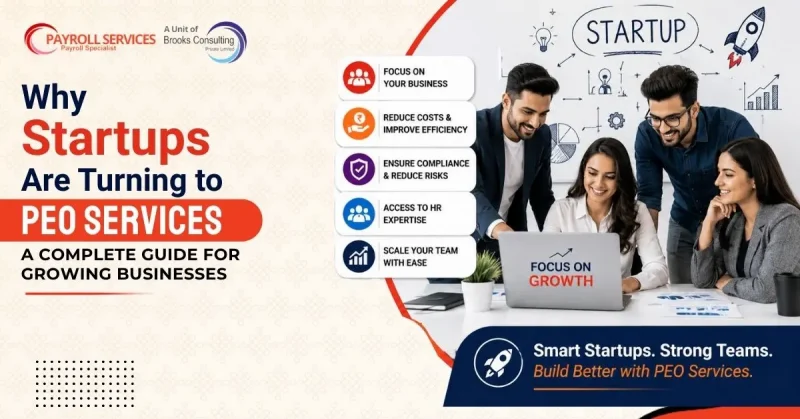
Why Startups Are Turning to PEO Services: A Complete Guide for Growing Businesses
Starting a business is exciting. Scaling one is a completely different challenge. Startups tend to grow at a staggering pace. A small company turns into a distributed workforce very quickly, as recruiting employees becomes a cross-state or cross-country process. Consequently, basic administrative processes have become much more complicated.
That is where Professional Employer Organization (PEO) services are proving to be useful.
Rather than hiring a massive HR and administrative team from the get-go, startups can rely on a PEO, outsourcing a significant portion of their employment-related duties to professionals who have experience in these areas. While founders and management teams focus on building products, acquiring customers, raising capital and managing growth, a PEO takes care of the administrative aspects of payroll, employee benefits, HR administration, compliance, workers’ compensation and more.
This could be an important competitive edge for a startup that has limited capital, limited time and a lean team.
The growing interest in PEO services is not just a matter of cutting down on administrative tasks. It’s the optimization of infrastructure which allows people to be managed at scale. With the competition for the best talent, the evaluation of talent for growth, the complexity of the employment laws, and the search for more efficient operations, PEO firms are not only used as an HR outsourcing service, but are becoming strategic partners to startups.
So, why are startups turning to PEO services?
The solution is in the ability to scale, cost-saving, adherence to regulations, employee benefits, risk management, HR proficiency and the ability to tend to internal resources to focus on growth.
This comprehensive guide explores what PEO services are, how they works, why startups utilize them, their core advantages, possible disadvantages, and the methods to identify if a PEO is compatible along with your growing business.
What Is a PEO?
A Professional Employer Organization (PEO) is a company that offers as an outsourced HR and employment-related service to businesses.
In a typical PEO arrangement, the startup becomes a co-employer of the PEO. Normally, the PEO will manage administrative and employment duties, and the startup will manage the day-to-day operations and core business of the company.
Some of the services offered by a PEO include:
- Payroll processing
- Employee benefits administration
- Human resources support
- Workers’ compensation administration
- Employment tax administration
- Regulatory compliance assistance
- Employee onboarding and offboarding
- HR documentation
- Risk management
- Employee handbooks and workplace policies
- Recruiting support
- Performance management
- Training and development
- Employment practices guidance
- Workforce reporting and analytics
Many PEO providers offer a variety of different services and it is important that startups understand what services are offered before entering into an agreement.
How Do PEO Services Work for Startups?
Overall, a PEO is an extension of a startup’s HR and administrative setups.
Suppose, for instance, that you are a technology company that has 25 staff members. The founders might have had to deal with payroll, benefits, and onboarding and also answer HR questions all by themselves. As the business expands, it is increasingly becoming a time consuming task of these duties and also raises compliance risks.
The startup can partner with a PEO.
The PEO can then handle various other tasks, such as payroll administration, benefits coordination, workers’ compensation, HR paperwork, and employment compliance assistance.
Meanwhile, the startup is accountable for vital choices on how to operate its business, including:
- Who to hire
- Who to promote
- Employee responsibilities
- Salaries within the agreed structure
- Work assignments
- Company culture
- Business strategy
- Product development
- Customer relationships
- Performance expectations
With this division, the founders can keep control over their company and delegate several tasks to experts.
Why Are Startups Turning to PEO Services?
There are no one-dimensional reasons for startups to opt for PEO services. Typically multiple pressures in the business come along at once.
When a startup is expanding, it can often require a quick response to hire employees while maintaining a manageable administrative burden. May require improvements in employee benefits to attract talent. It could also be moving to new jurisdictions with varying employment laws.
Meanwhile, the founders do not wish to invest huge amount of their precious resources in developing a costly in-house HR on-site until it is a dire need.
Many of these challenges can be solved with PEO services at once.
These are some of the top drivers that are compelling startups to consider PEO solutions.
1. PEO Services Help Startups Scale Faster
Growth creates complexity.
HR management can be informal for a startup that has only a few employees. For 50, 100, or 500 employees, it is not the same processes that are used.
As employee numbers increase, startups must manage:
- Payroll schedules
- Employee records
- Benefits enrollment
- Tax documentation
- Leave policies
- Employment regulations
- Workers’ compensation
- Hiring processes
- Onboarding
- Employee relations
- Compliance documentation
When high growth rates don’t go along with adequate infrastructure, founders and managers can be overwhelmed.
A PEO can offer proven HR systems and processes that enable the company to expand its staff while maintaining a similarly sized administrative headache.
This makes PEO services ideal for startups with swiftly growing staff.
2. Startups Can Access Professional HR Expertise
A good number of start-ups don’t have a full-time HR team in its infancy.
That’s a common issue that is faced by founders and managers – where they have to take care of HR themselves.
They may have questions such as:
- How should employees be onboarded?
- What should an employee handbook include?
- How should workplace complaints be handled?
- What employment documentation is required?
- How should leave policies be structured?
- What should be included in a termination process?
- How can the company reduce employment-related risks?
With the help of a PEO, startups can have access to HR professionals and third-party processes, irrespective of whether the startup has a large HR department in place.
This is useful, especially for founders who are adept in areas like technology and finance but are not experts in human resources.
3. PEOs Can Simplify Payroll Management
One of the significant functions of the business administration is its payroll system.
Staff members are expecting to receive the correct pay on time. Human error can lead to loss of confidence among employees, compliance problems and loss of management time.
PEO payroll services can assist companies in handling some processes, including:
- Payroll calculations
- Payroll schedules
- Tax withholding
- Payroll reporting
- Employee deductions
- Direct deposits
- Payroll records
- Year-end payroll documentation
Startups can save time in-house by delegating payroll management.
The most significant advantage is that the founders can focus on the strategic priorities, instead of worrying about administrative payroll processes.
4. PEO Services Can Help With Employment Compliance
Employment compliance becomes increasingly complicated as a company grows.
There may be variations in requirements across jurisdictions with regard to:
- Minimum wage
- Overtime
- Employee classification
- Paid leave
- Workplace safety
- Employee records
- Payroll taxes
- Workers’ compensation
- Anti-discrimination requirements
- Hiring documentation
- Termination procedures
A start-up company that grows to a multi-state operation can find itself suddenly having to know multiple sets of regulations.
PEO providers typically have HR and compliance experts that help businesses with their responsibilities.
It is important to note that a PEO does not remove the legal liability from the startup, and businesses must not believe that by handing over HR to outsiders, they do not have any compliance duties. But when HR professionals help with compliance, it can be much easier to manage.
5. Better Employee Benefits Can Help Startups Attract Talent
One of the greatest hurdles that expanding startups must deal with is recruiting new employees.
Large companies may offer competitive salaries, health insurance, retirement plans, paid leave, wellness programs, and other benefits.
Small startups have a hard time giving a compensation package like this.
This is where PEOs can make a valuable contribution.
Depending on who provides the services, where they are based, how many employees it has and the flexibility of the benefits offered, PEOs could offer a larger choice of benefits to a business than it would be able to secure on its own.
Potential benefits may include:
- Health insurance
- Dental insurance
- Vision insurance
- Retirement plans
- Life insurance
- Disability coverage
- Employee assistance programs
- Wellness benefits
- Flexible spending arrangements
An enhanced benefits package can help a startup attract top talent.
6. PEOs Can Help Startups Manage Employment Risk
If not controlled, employment-related risks can turn into costly occurrences.
Potential issues can involve:
- Employee disputes
- Workplace injuries
- Discrimination claims
- Harassment allegations
- Wage and hour issues
- Incorrect employee classification
- Poor documentation
- Inconsistent HR policies
- Unclear termination procedures
A PEO can offer guidance and compliance, risk-management support, and administration of worker’s compensation.
They do not seek to completely eliminate all risks. Rather, HR systems can be employed to startups to find potential issues earlier and set up more consistent processes to address them.
7. Startups Can Reduce Administrative Work
Founders have limited time.
An hour invested in payroll issues, employee documents, employment law, donor communication, strategy, etc. is not an hour invested in product development, sales, fundraising, strategy, or customers.
PEO services can consolidate numerous administrative tasks.
Startups might be able to get access to various HR services from one provider, as opposed to using a number of distinct systems and vendors.
This can lead to a more efficient administrative process.
8. PEO Services Can Improve Employee Onboarding
First impressions matter.
A disorganized onboarding process can make new employees question the company’s professionalism.
A well-designed onboarding process can help employees understand:
- Their role
- Company policies
- Compensation
- Benefits
- Payroll procedures
- Workplace expectations
- Required documentation
- Communication channels
- Company culture
PEOs can assist startups in setting up consistent administrative processes and onboarding procedures.
This can be especially helpful when a company is hiring several employees simultaneously.
9. PEOs Can Support Multi-State Expansion
A major advantage for growing startups using PEO services is the option to enable expansion of the workforce in other jurisdictions.
The startup can start from a city and then move to several states with their employees.
Expansion may develop new administrative problems without adequate infrastructure.
For instance the business could be required to handle various types of:
- Employment regulations
- Payroll requirements
- Tax obligations
- Workers’ compensation rules
- Leave requirements
- Wage regulations
Many of these employment processes can be centralized by a PEO with multi-state functionality.
This can help to make the process of geographic expansion more manageable.
10. PEO Services Allow Founders to Focus on Growth
There are a number of reasons why startups rely on PEO services, perhaps the greatest being:
The founders should concentrate on the business.
Some of the key things to consider for a startup include:
- Building a product
- Finding product-market fit
- Acquiring customers
- Increasing revenue
- Raising investment
- Developing partnerships
- Building a strong team
- Expanding into new markets
HR administration is critical, but it should never take up most of the time of the founder.
Outsourcing specific HR tasks will enable the top management to focus on their core competencies while letting specialists handle the administrative tasks.
PEO vs. Traditional HR: What’s the Difference?
The traditional way calls for the development of the company’s own HR organizational structure.
That may involve hiring:
- HR managers
- Payroll specialists
- Benefits administrators
- Compliance professionals
- Recruiters
- HR coordinators
This can be very effective at a certain point in a business.
But for smaller startups, it may not be a budget they can afford or labor force that is large enough to support a huge human resources team.
Many of these capabilities are available via an external party through a PEO.
Traditional In-House HR
The company has an internal HR function.
Advantages:
- Direct control
- Internal institutional knowledge
- Customized processes
- Dedicated employees
Potential disadvantages:
- Higher staffing costs
- More administrative infrastructure
- Recruitment challenges
- Greater management overhead
PEO Model
The company has an external PEO partner.
Advantages:
- Access to HR expertise
- Outsourced administration
- Potentially broader benefits access
- Compliance support
- Scalable infrastructure
- Reduced administrative burden
Potential disadvantages:
- Service fees
- Less direct control over some administrative processes
- Dependence on an external provider
- Need for careful vendor evaluation
The right selection will depend on the size, growth and number of employees, budget, location, and in-house capabilities of the startup.
PEO vs. Payroll Service Provider
A Professional Employer Organization (PEO) is different from a payroll company.
Payroll service providers are focused on payroll and payroll tax processing.
On the other hand, a PEO can offer a larger scope of services relating to employment.
| Service | Payroll Provider | PEO |
| Payroll processing | Yes | Yes |
| Payroll tax administration | Usually | Usually |
| Benefits administration | Limited/varies | Often |
| HR support | Limited | Yes |
| Compliance support | Limited | Often |
| Workers’ compensation | Limited/varies | Often |
| Risk management | Limited | Often |
| Employee onboarding | Limited | Often |
| Broader HR infrastructure | Limited | Yes |
When a startup company strictly requires payroll processing only, payroll service providers will be enough.
However, when the startup needs HR infrastructure, benefits, compliance, and workforce administration, then a PEO may be a more suitable choice.
What Services Does a PEO Typically Provide?
PEO offerings can differ, but extensive providers could supply the following.
Payroll Administration
This may encompass payroll processing, deductions, payroll reporting, and payroll records.
Human Resources
HR professionals can support employee relations, documentation, HR processes, policies and assistance in onboarding.
Employee Benefits
PEOs can offer health plans, pension plans, and other employee perks.
Workers’ Compensation
PEOs can assist in managing their workers’ compensation programs and those processes.
Compliance
PEOs can help companies fulfill employment-related regulatory obligations and HR paperwork.
Risk ManagementBusines
ses can find services for the management of risk that can help them create more secure and uniform employment practices.
Technology
Many PEOs offer HR technology solutions that include time tracking, employee information management, reporting, payroll and benefits.
The Financial Benefits of PEO Services for Startups
Cost Savings is one of the important factors that most often enter into the thoughts of startups.
But the startup shouldn’t only consider PEO pricing based on the HR employee’s salary.
The actual value may comprise of multiple elements.
Reduced Administrative Labor
Less time on manual HR-related tasks for employees and managers.
Access to HR Expertise
The company doesn’t have to hire a number of HR experts at once.
Potential Benefits Advantages
Depending on the PEO and various plans, a start-up may access benefits programs that would be hard to come by or too costly if they were not available.
Reduced Compliance Risk
Standardized procedures and professional advice can help minimize potential expenses due to error in administration.
Scalable Infrastructure
The startup may have the ability to grow their staff without needing to start over and re-construct HR systems.
The important question is not simply:
“How much does a PEO cost?”
The better question is:
“What does the PEO save us in time, labor, risk, infrastructure, and management attention?”
When Should a Startup Consider Using a PEO?
There is no universal employee-count threshold.
If the number of employees become complicated for a startup to manage, it is time to seek the aid of a PEO.
Common signs include:
You’re Hiring Rapidly
Manual HR processes can become challenging if your business is hiring employees rapidly.
Founders Are Doing HR
When founders are spending large amounts of time on employment matters like onboarding, payroll and benefits management, it may be the right time to outsource.
You’re Expanding Into New States
The process of hiring in multiple states may be quite complex.
Employees Are Asking for Better Benefits
A PEO can offer the option for greater benefits alternatives.
HR Mistakes Are Increasing
Warning signs are repeated payroll issues, documentation or compliance issues.
You Need Professional HR Guidance
When employers are often finding themselves at a loss for answers regarding their employees’ behavior, policies, performance, or workplace practices, outside HR expertise can be of benefit.
What Are the Potential Drawbacks of PEO Services?
PEO services can be a good thing, but it’s not necessarily the right thing for every startup.
Businesses need to take into account any drawbacks.
Cost
PEO services come at a cost. The startup should analyze the overall price and cost with the value of the services used.
Less Direct Administrative Control
Certain HR and payroll functions will be handled by the PEO’s systems and processes.
Provider Dependence
The startup relies on another organisation for vital administrative services.
Benefits Limitations
Eligibility and the types of insurance and benefits offered will depend on the PEO, geographic region, size of the workforce and other factors.
Contract Terms
Prior to signing, it is crucial for startups to examine the pricing, service contracts, cancellation terms, implementation conditions and requirements, and the responsibilities.
The PEO relationship’s best form is when roles are clearly established and the service provided by the PEO aligns with the company’s current needs.
How to Choose the Right PEO for Your Startup
Pick a good PEO is an important business decision.
Don’t just opt for a provider because of price.
Rather, consider the total service offering.
1. Review the Service Portfolio
Figure out if the provider actually provides the services that your startup needs.
Ask about:
- Payroll
- Benefits
- HR
- Compliance
- Workers’ compensation
- Risk management
- Technology
- Recruiting support
2. Evaluate Technology
A modern HR platform should be intuitive, reliable, secure, and easy for employees and administrators to use.
3. Understand Pricing
Inquire on the exact method for calculating fees.
Some possible pricing options are:
- Per employee
- Percentage of payroll
- Administrative fees
- Separate benefit costs
- Additional service charges
Request a detailed pricing breakdown.
4. Check Compliance Capabilities
Ask the PEO about their ability to support businesses as their employment regulations change.
5. Examine Customer Support
If a problem with payroll processing occurs or an employee issue comes up, a startup needs to know who they need to reach out to.
Ask about:
- Dedicated account managers
- Response times
- Support hours
- HR specialists
- Escalation procedures
6. Review Benefits
When benefits are a key factor, do some thorough research.
7. Understand the Co-Employment Relationship
Show how to apply skills in a real industry context.
8. Look for Industry Experience
A PEO with an in-depth knowledge of startups, tech firms, professional services, etc. can have a better grasp of your employee requirements.
PEO Services and Startup Employee Retention
Hiring employees is only half the challenge.
Keeping talented people is equally important.
Employee retention can be influenced by:
- Compensation
- Benefits
- Workplace culture
- Career development
- Leadership
- Flexibility
- Recognition
- Job satisfaction
- HR responsiveness
Several of these aspects can be assisted by a professional HR infrastructure.
A positive employee experience can be achieved through reliable payroll processing, easy access to benefits, organized induction process, transparent policies, and responsive HR support.
A PEO is not the one that is responsible for developing a great company culture; it is the leader who is responsible for developing it, and the PEO is a foundation upon which they can do so.
PEO Services Can Give Startups a Competitive Hiring Advantage
One of the most important assets of a startup is talent.
Compensation alone may not be enough to win in a startup to challenge the established companies.
But it must make a strong overall offer of employment.
When a young company offers professional benefits administration, a structured onboarding process and supports its employees with HR, it looks more grown up and believable.
This is important if the candidate is considering whether to take a job in a small startup or a big employer.
PEO Services for Remote and Distributed Teams
For many companies, workforce management has become more difficult with the advent of remote working.
A startup may have employees working from:
- Different cities
- Different states
- Multiple regions
- Hybrid offices
- Remote locations
When it comes to managing a distributed workforce, the right systems for payroll, benefits, employment documentation, compliance and HR administration are essential.
For startups, these processes can be streamlined with a PEO that has strong multi-state capabilities.
Startups, however, should verify that a particular PEO is able to provide the jurisdiction(s) in which they intend to hire.
PEO vs. Building an Internal HR Department
At some point, many startups might choose to perform some HR functions internally.
That doesn’t necessarily mean that the use of a PEO was a bad idea.
A PEO can fill the gap between the HR functions of an informal, founder-driven HR team and the more established internal HR function.
In the beginning, a startup may delegate most of its HR duties and responsibilities.
It can employ an HR manager as it expands.
It can develop an HR team consisting of:
- HR leadership
- Recruiters
- Payroll professionals
- Benefits specialists
- HR business partners
- People operations staff
The appropriate model can change as the company grows.
The ultimate aim is not to ‘outsource’ HR indefinitely.
The aim is to create the appropriate infrastructure in the proper stage of the company.
The Strategic Value of PEO Services
The worst thing you can do is think of a PEO as just an administrative vendor.
A PEO could be a key component of a startup’s growth plans.
Consider the infrastructure of the startup as three layers:
Business Operations
Product, sales, marketing, customers, finance, and strategy.
People
Hiring, compensation, benefits, culture, performance, and employee experience.
Administration
Payroll, compliance, documentation, HR systems, and risk management.
A PEO can help reinforce second and third layers so that they can pay more attention to the first layer.
This is what makes PEO services so much more than payroll.
Are PEO Services Worth It for Startups?
Yes, for many startups on the rise — especially those that are growing quickly, expanding to a new location, don’t have HR professionals on staff or require a more complex employee benefits and compliance setup.
However, a PEO is not automatically the best solution.
A startup should compare:
PEO cost + benefits + HR support + administrative savings + risk management
against:
Internal HR cost + payroll systems + benefits administration + compliance resources + management time.
This comparison is descriptive of value as it is seen in a broader context.
PEO Services: A Smarter Way to Support Startup Growth
In the startups, it is always a pressure situation.
They need to move quickly, control costs, hire high top talent staff, keep investors interested, keep within compliance requirements, and develop long-term operations.
Taking on all HR duties in-house can be a real time sink.
PEO services are a solution to delegate various complicated employment-related duties while controlling the enterprise.
Whether it’s payroll, benefits administration, HR support, compliance, workers’ compensation, or risk management, a PEO provides the many infrastructures that have a growing startup need without it having an immediate need to establish a large HR department.
The outcome may be a more manageable, structured and worker pleasant enterprise.
Conclusion: Why PEO Services Are Becoming a Startup Growth Tool
Modern startup landscape is all about speed, flexibility and efficiency.
However, infrastructure-less speed can cause issues.
When startups expand, managing people’s operations start becoming complex. The payroll, benefits, HR policies, employment laws, workers’ compensation, employee relations, and administrative processes quickly add pressure on founders and small teams of managers.
This is the reason why more startups are venturing into the PEO services.
A PEO can offer the HR infrastructure required to help grow your business, while your founders can concentrate on the bigger picture.
The right PEO can help a startup:
- Scale its workforce
- Streamline payroll
- Strengthen HR processes
- Improve employee benefits
- Support compliance
- Manage employment risks
- Simplify multi-state hiring
- Improve onboarding
- Reduce administrative workload
- Focus more time on growth
Ultimately, the question is not whether every startup needs a PEO.
The better question is:
Does your HR infrastructure help your startup expand and grow or is it limiting you?
If your team spends lots of time on the payroll, benefits, HR processes, labor laws, and administrative processes, it can be a perfect time to consider having a PEO come in to help your company grow.
Ready to Make HR Easier and Growth More Scalable?
FAQs About PEO Services
1. What does PEO stand for?
PEO: Professional Employer Organization. A PEO offers outsourced human resources and employment-related services to businesses – often in a co-employment relationship.
2. Why do startups use PEOs?
Startups use PEOs to make HR management easier, process payroll, access employee benefits, receive HR guidance, improve compliance with regulations, and increase employee count in an efficient manner.
3. Is a PEO the same as a payroll company?
No, the payroll companies deal only with payroll issues, while PEOs operate with a wider range of HR-related issues such as benefits, compliance, workers’ compensation, and administrative issues.
4. Can a PEO help with employee benefits?
Yes. Depending on the PEO and applicable plans, many PEOs may also offer employee benefits administration, health insurance, retirement plans and other benefits.
5. Can startups use PEO services for remote employees?
Indeed, distributed and multi-state workforces can be supported by many PEOs. But it’s important for startups to check whether the jurisdiction they choose to operate in with the PEO supports their employees.
6. How much does a PEO cost?
PEO pricing can differ depending on the workforce size, payroll, services chosen, benefits, location, and pricing models of the PEO. Estimates are not appropriate for startups; instead, request a custom estimate.
7. Is a PEO suitable for a small startup?
It can be. The decision is not as simple as the number of employees, but also depending on the administrative complexity of the startup, growth plans, HR needs, geographic reach and available internal resources.