
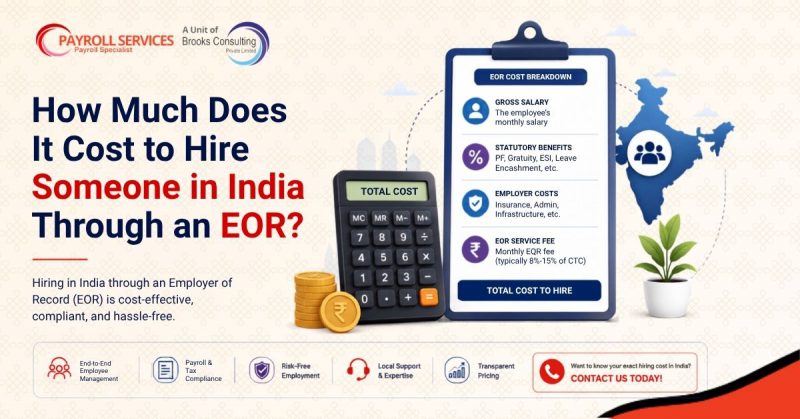
How Much Does It Cost to Hire Someone in India Through an EOR?
Hiring employees in India can give international companies access to skilled professionals at competitive costs. However, establishing a legal entity, managing payroll and complying with Indian employment laws can be complicated and expensive.
An Employer of Record (EOR) offers a simpler solution. It enables a foreign company to hire employees in India without establishing its own local entity. But how much does this service actually cost?
What Is the Average EOR Cost in India?
The total monthly cost of hiring an employee through an EOR usually includes:
Employee salary + employer contributions + employee benefits + EOR service fee + applicable taxes or additional charges
Published India EOR prices commonly range from approximately $199 to $650 per employee per month, although some local providers may offer lower rates and global platforms may charge more. Pricing varies according to the provider, employee count and services included.
The EOR fee is separate from the employee’s salary, statutory employer contributions and benefits.
Main Components of EOR Costs in India
1. Employee Salary
The employee’s salary is usually the largest part of the total employment cost. It depends on factors such as:
- Job role and experience
- Industry and required skills
- Employee location
- Current market demand
- Bonuses and incentives
- Salary structure
Professionals working in Bengaluru, Gurgaon, Mumbai, Hyderabad, Pune and Delhi may command higher salaries than those in smaller cities.
2. EOR Service Fee
The EOR charges an administrative fee for becoming the employee’s legal employer and managing responsibilities such as:
- Preparing locally compliant employment contracts
- Processing monthly payroll
- Calculating and deducting taxes
- Making statutory contributions
- Administering employee benefits
- Maintaining employment records
- Managing onboarding and offboarding
- Supporting compliance with Indian labour laws
EOR providers generally use one of two pricing structures:
Fixed monthly fee: A predetermined amount is charged for every employee each month.
Percentage-based fee: The provider charges a percentage of the employee’s salary, commonly around 10%–15%.
A fixed fee may offer better cost predictability, particularly when hiring senior or highly paid employees.
3. Provident Fund Contributions
The Employees’ Provident Fund is an important statutory benefit in India. Both the employer and employee generally contribute 12% of basic wages plus dearness allowance, subject to the applicable eligibility rules and statutory wage ceiling.
The employer’s contribution is normally treated as part of the employee’s overall employment cost. The amount can vary depending on the salary structure and whether contributions are limited to the statutory ceiling or made on higher eligible wages.
4. Employees’ State Insurance
Employees’ State Insurance may apply to employees whose wages fall within the relevant eligibility limit.
The employer contribution is currently 3.25% of applicable wages, while the employee contributes 0.75%.
Employees earning above the applicable wage threshold may instead receive private medical insurance as part of their benefits package.
5. Gratuity
Gratuity is a statutory end-of-service benefit for eligible employees. Under the applicable formula, it is generally based on 15 days’ wages for every completed year of service.
EOR providers may include a monthly gratuity provision in the employee’s cost-to-company structure. This is often estimated at approximately 4.81% of basic salary, although the actual liability depends on the employee’s eligibility, employment category and length of service.
6. Insurance and Additional Benefits
Depending on the employment package and company policy, additional costs may include:
- Group medical insurance
- Personal accident insurance
- Life insurance
- Performance bonuses
- Meal or travel allowances
- Wellness benefits
- Equipment and internet allowances
- Enhanced paid leave
- Learning and development support
These benefits may not always be legally required, but they can help employers attract and retain skilled professionals.
Sample EOR Cost Calculation
Suppose a foreign company hires an employee in India with a gross annual salary of ₹12,00,000.
| Cost component | Illustrative annual cost |
| Gross employee salary | ₹12,00,000 |
| Employer provident fund | ₹21,600–₹57,600 |
| Estimated gratuity provision | Approximately ₹23,000 |
| Medical insurance and benefits | ₹20,000–₹50,000 |
| EOR service fee | ₹2,00,000–₹6,50,000 |
| Estimated total annual cost | ₹14,64,600–₹19,80,600 |
In this example, the approximate monthly employment cost would be between ₹1.22 lakh and ₹1.65 lakh.
This calculation is illustrative. The actual amount depends on the employee’s salary structure, applicable statutory schemes, EOR pricing, insurance plan, foreign-exchange rate and additional benefits.
Are There Any Additional EOR Charges?
Some providers may charge separately for services that are not included in their standard monthly fee. These can include:
- Employee onboarding or setup
- Security deposits
- Employment contract amendments
- Visa and immigration support
- Background verification
- Laptop and equipment management
- Expense reimbursement processing
- Variable payroll runs
- Employee termination
- Severance administration
- Foreign-exchange conversion
- Deposit refunds or early contract closure
Businesses should therefore request a detailed cost breakdown before signing an EOR agreement.
What Factors Affect EOR Pricing?
The final price is commonly influenced by:
- Number of employees being hired
- Employee salaries and seniority
- Location of the employees
- Benefits selected by the company
- Contract duration
- Payroll complexity
- Immigration requirements
- Currency conversion method
- Employment termination risk
- Level of HR and legal support required
Companies hiring several employees may be able to negotiate volume-based pricing.
EOR Versus Establishing an Indian Entity
An EOR may appear more expensive on a per-employee basis because of its monthly service fee. However, establishing an Indian entity involves incorporation costs, accounting, tax registrations, legal support, payroll infrastructure, compliance filings and ongoing administration.
An EOR is generally more practical when a company:
- Wants to hire quickly
- Is testing the Indian market
- Plans to employ a small or medium-sized team
- Does not want to establish an Indian subsidiary immediately
- Needs local payroll and compliance support
Establishing an entity may become more economical when the company has a large, permanent workforce and long-term operations in India.
How to Compare EOR Providers
Do not compare providers using the advertised monthly fee alone. Ask each provider for a complete, itemised quotation covering:
- Monthly EOR fee
- Employer statutory contributions
- Insurance and benefit costs
- Setup and onboarding charges
- Foreign-exchange margins
- Deposit requirements
- Offboarding and termination fees
- Minimum contract period
- Services included in the standard package
Transparent pricing makes it easier to calculate the true cost of employment and prevents unexpected expenses.
Conclusion
Hiring someone in India through an EOR typically involves the employee’s salary, statutory employer contributions, benefits and an EOR fee that may range from approximately $199 to $650 per employee per month.
Although the precise cost varies, an EOR can help international companies enter India quickly, reduce administrative work and hire legally without establishing a local entity. Before selecting a provider, businesses should obtain a detailed quotation and evaluate the complete employment cost—not just the advertised EOR fee.
Brooks Consulting helps international businesses hire and manage employees in India through compliant EOR solutions. Contact our team to receive a customised cost estimate for your India hiring requirements.